
Rainy-Day Indoor Activities in Palm Springs
When it rains in Palm Springs, the main indoor alternatives are museums and exhibitions, galleries, active or hands-on entertainment, and relaxation-focused experiences. Choose the category that fits the rain intensity, time available, location and group needs; during persistent or heavier rain, favour a fully sheltered activity with minimal outdoor transition exposure.
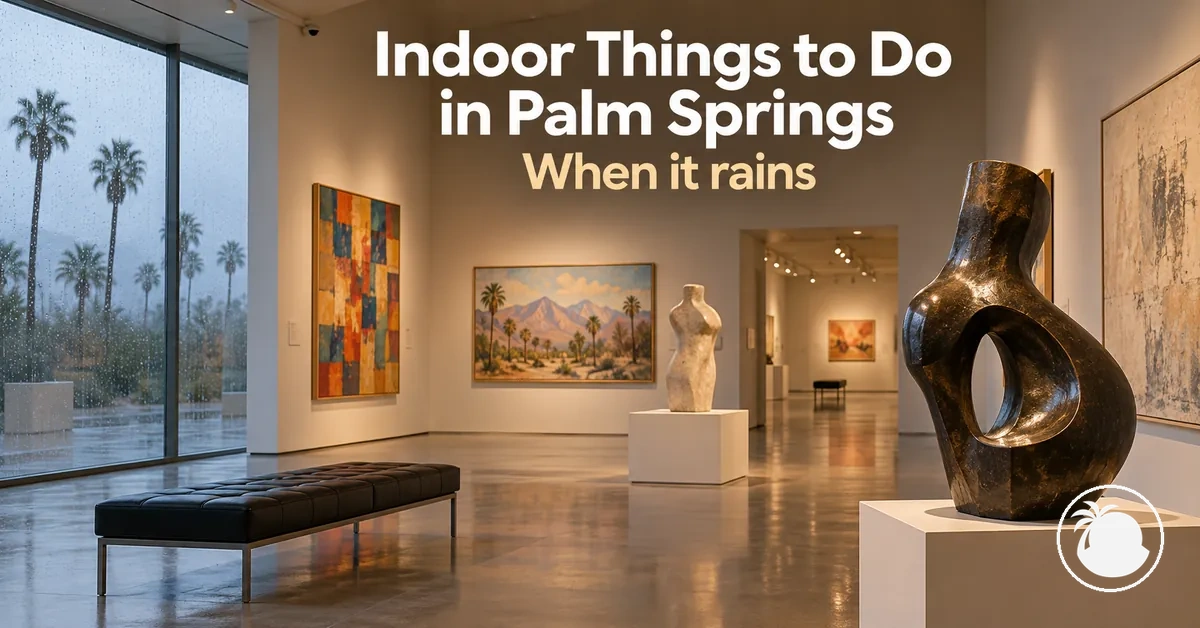
Choose an indoor option by your main constraint
Start with what the rainy-day plan needs to achieve, then check venue-specific opening, booking and access conditions before relying on a particular stop.
- Culture + a longer sheltered visit
- Choose a museum or exhibition space. Compare subject focus, visit commitment, family fit and whether any displays or transitions remain outdoors.
- Culture + a short flexible stop
- Choose a gallery or indoor art space. A single venue can keep the visit flexible; combining several spaces increases time and outdoor movement between them.
- Shared active entertainment
- Consider an escape room or bowling. Match the activity to group size, ages, participation style, session timing and any booking requirement.
- Hands-on participation
- Consider a creative indoor activity. This can suit visitors who want to make or complete something rather than spend the whole visit observing displays.
- Quiet downtime
- Consider a spa or sheltered wellness experience. Check appointment or reservation rules, age or access conditions and whether the facilities you plan to use are actually indoors.
- Limited evening or tight schedule
- Prioritise verified operating hours and a manageable activity duration. Booking dependence and the amount of rain exposure during arrival and departure can determine whether the option still fits.
Rain rule: the heavier or more persistent the rain, the more weight to give to complete indoor protection and low-exposure transitions. For a brief shower, a nearby flexible stop may be enough.
The sections below move from cultural attractions to entertainment and relaxation, then show how to adapt the choice for downtown visits, families, evenings and itinerary changes.
Table of Contents
Indoor Attractions and Cultural Activities for Rainy Weather
Indoor cultural attractions in Palm Springs include museums, exhibition spaces, and art venues that provide sheltered alternatives when rain makes outdoor sightseeing less practical.
Museums and exhibition spaces can support a longer cultural visit centred on learning or viewing collections, while galleries and other art venues may suit a shorter, more flexible stop.
These functions, rather than popularity, determine how each cultural activity type can fit a rainy-day plan.

Rainy-day suitability differs by indoor protection, time commitment, location convenience, and family fit.
Admission and opening conditions may also differ by venue or date, so those operational details require current verification before a visit.
Choose the activity category first, then compare venue-level opening, admission, access and indoor-coverage details before selecting a specific stop.
- Museums: suit visitors seeking a longer indoor cultural visit with learning, collections, or exhibits as the main activity.
- Exhibition spaces: provide indoor protection for visitors who want to focus on a particular display or cultural subject, with the required time commitment depending on the exhibition.
- Family-compatible cultural venues: may fit mixed-age groups when the exhibits, indoor coverage, admission conditions, and practical access suit the group's needs.
- Galleries and indoor art venues: can work as shorter, flexible cultural stops when their location and current opening conditions fit the day's plans.
Specific differences among museums, exhibition spaces, galleries, and art venues are better assessed at venue level in the more detailed categories that follow.
Museums and Exhibition Spaces
Palm Springs museums and exhibition spaces differ primarily by subject focus and the kind of indoor visit they offer.
Art collections, aviation exhibits, and cultural-history exhibitions provide distinct learning experiences, so the most suitable museum depends on visitors' interests and the time available.
Comparing these differences helps visitors choose an indoor activity without assuming every museum offers the same degree of indoor protection.
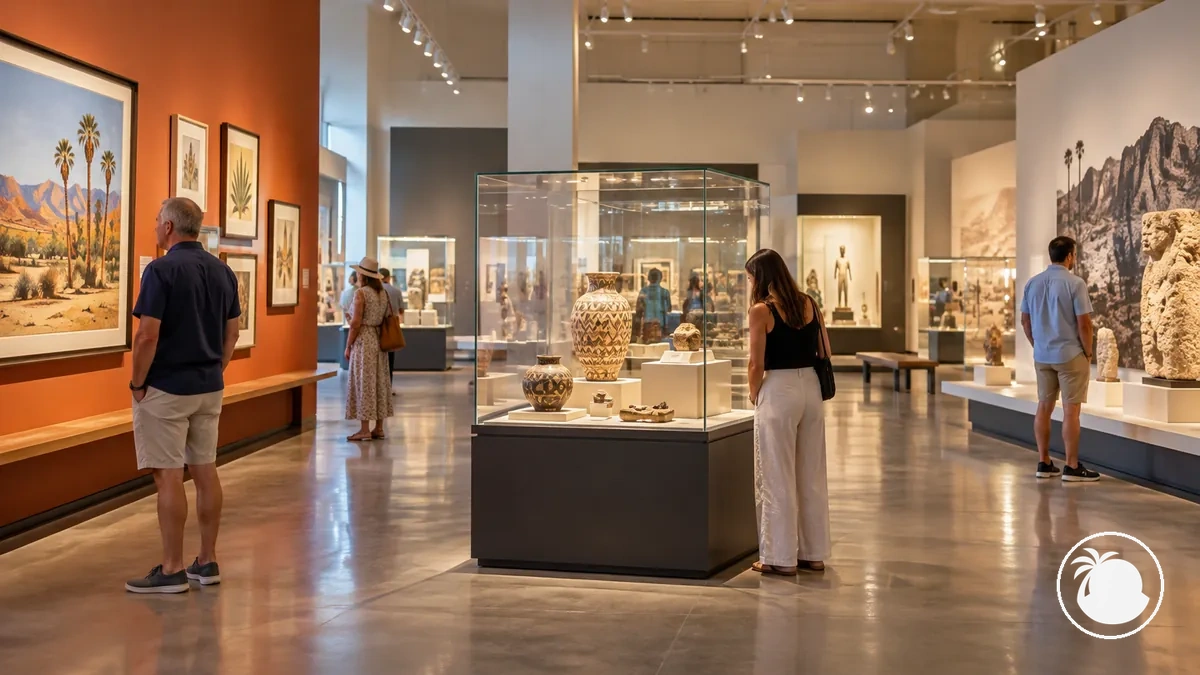
Subject focus is the first selection criterion, followed by expected visit length, family suitability, indoor coverage, and access conditions.
A museum with several galleries or aircraft hangars may justify a longer visit, while a focused exhibition may suit a shorter schedule; these are planning distinctions rather than fixed duration estimates.
Family suitability depends on the group's interests, the exhibits available, and any age or access restrictions.
For rainy-weather planning, distinguish sheltered galleries and hangars from outdoor displays, trails or transitions that can still expose visitors to rain.
| Museum or Exhibition Space | Primary Focus | Typical Visit Commitment | Family Fit | Indoor/Access Notes |
|---|---|---|---|---|
| Palm Springs Art Museum | Modern and contemporary art, photography, architecture, design, and exhibitions. | Flexible gallery visit; additional collections or exhibitions may increase the time needed. | May suit families interested in visual art; suitability depends on current exhibitions and children's interests. | Indoor galleries provide sheltered viewing, while outdoor cultural spaces should not be treated as protected from rain. |
| Palm Springs Air Museum | Aviation history, military aircraft, and related historical exhibits. | May require a longer visit when several hangars and aircraft displays are included. | May suit families interested in aircraft and history, including interactive exhibits. | Exhibition hangars provide indoor coverage, but some aircraft displays and movement between areas can involve outdoor exposure. |
| Agua Caliente Cultural Museum | History, traditions, cultural expression, and contemporary experiences of the Agua Caliente Band of Cahuilla Indians. | The museum's visitor guidance recommends allowing approximately 1–2 hours for both galleries; individual visit length may differ. | May suit families interested in Indigenous history, culture, and audiovisual exhibitions. | Permanent and changing galleries are indoors, while the associated Oasis Trail is outdoors and may be less practical during rain. |
Verify current opening conditions, admission requirements, exhibition availability, and weather-related access details with the relevant museum before visiting.
Art Galleries and Indoor Art Spaces
Palm Springs art galleries and indoor art spaces can work as flexible cultural stops for visitors who prefer shorter browsing periods or want an indoor activity near other plans.
Unlike a museum-scale cultural visit that may involve several collections or exhibition areas, gallery browsing can be organised around one or several smaller art spaces, with the practical time commitment shaped by the number and location of spaces visited.
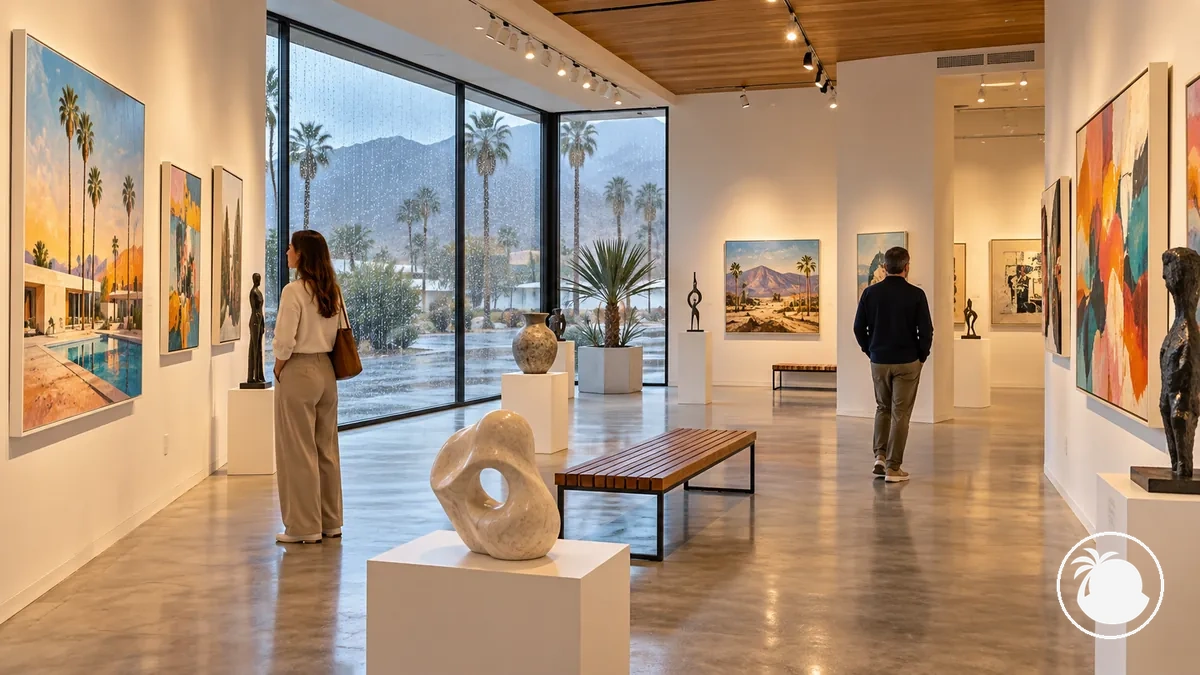
Location and indoor coverage determine how practical an art space is during rain, particularly when an itinerary involves walking between separate venues.
Visit length can remain flexible when browsing a single gallery, but visiting several spaces requires more time and may increase outdoor exposure between them.
Admission expectations and opening hours can differ by venue and day, so neither entry conditions nor availability should be assumed from the type of gallery alone.
- Commercial art galleries: provide indoor browsing of displayed works and may suit a shorter cultural stop when their location and current opening conditions fit the itinerary.
- Artist and studio spaces: can provide a more focused exhibition experience, but public access and opening hours may be limited to particular periods or events.
- Multi-gallery areas: allow visitors to combine several gallery spaces, although moving between separate locations can reduce indoor coverage during heavier rain.
Verify current opening hours, admission conditions, and public access before relying on a specific gallery or indoor art space as a rainy-day stop.
Indoor Entertainment and Relaxation for Rainy Weather
Indoor entertainment and relaxation options broaden a Palm Springs rainy-day plan beyond cultural attractions by providing three distinct experience classes: active entertainment, hands-on activities, and relaxation-focused experiences.
Escape rooms and bowling involve more active participation, creative activities provide a hands-on format, and spa experiences emphasise a slower pace.
These categories can suit different groups depending on how much participation and activity they want while remaining indoors.
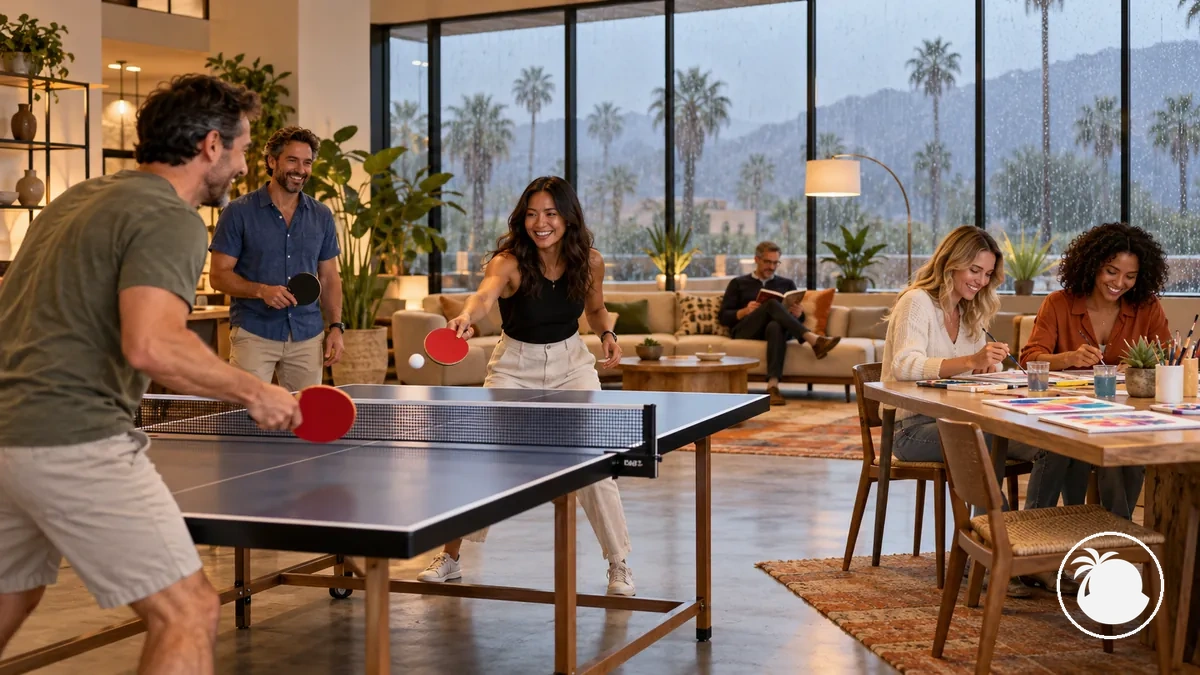
Group size and age mix affect whether a shared recreational activity or a quieter individual experience is suitable, while desired activity level separates active options from creative or relaxation-focused choices.
Time commitment depends on the activity format, and activities with scheduled sessions may require a reservation rather than allowing spontaneous entry.
Indoor coverage also matters during persistent rain because some venues may involve outdoor movement before or between activities, so the degree of shelter should be checked along with current access and reservation conditions.
- Active entertainment: escape rooms, bowling, and similar indoor entertainment tend to fit groups seeking shared participation and a higher activity level; age requirements, group-size limits, session timing, and reservation conditions should be checked for the chosen activity.
- Hands-on creative activity: creative activities can suit families, mixed-age groups, or visitors who prefer participatory indoor experiences at a less physically active pace; suitability depends on the activity format, expected visit length, age conditions, and available indoor coverage.
- Relaxation: spa experiences and other relaxation-focused options may suit visitors seeking a quieter pace or lower activity level, with suitability shaped by the services offered, time commitment, reservation requirements, and how fully the experience remains indoors.
Current access, age conditions, reservation requirements, and indoor coverage should be verified for the selected activity before relying on it as a rainy-day alternative.
Escape Rooms, Bowling, and Hands-On Indoor Activities
Escape rooms, bowling, and hands-on activities differ mainly in participation style, group fit, and booking dependence rather than simply providing interchangeable indoor recreation.
Escape rooms centre on collaborative puzzle solving, bowling provides a shared physical activity with turn-based participation, and creative activities involve making or completing something through direct participation.

Group fit varies with the venue's participation rules, the group's ages and interests, and how actively everyone wants to take part.
Time commitment and booking dependence also vary by venue and activity format, so exact session length and whether advance booking is needed should be verified for the chosen option.
Indoor coverage can provide shelter during the activity, but visitors should check whether arrival, waiting areas, or movement between activity spaces involves outdoor exposure.
- Escape rooms: involve collaborative puzzle solving and can fit couples or groups who want a structured shared challenge; participation requirements, group limits, booking arrangements, and session length depend on the specific experience.
- Bowling: combines physical participation with turn-taking, which can fit groups wanting an activity where participants are not continuously active at the same time; lane access, group arrangements, booking needs, and expected time commitment vary by venue and visit conditions.
- Hands-on creative activities: involve direct participation in a creative task and may suit families, couples, or groups who prefer making something over competitive recreation; the activity format determines participation requirements, booking dependence, and the time needed.
Spas and Relaxing Indoor Experiences
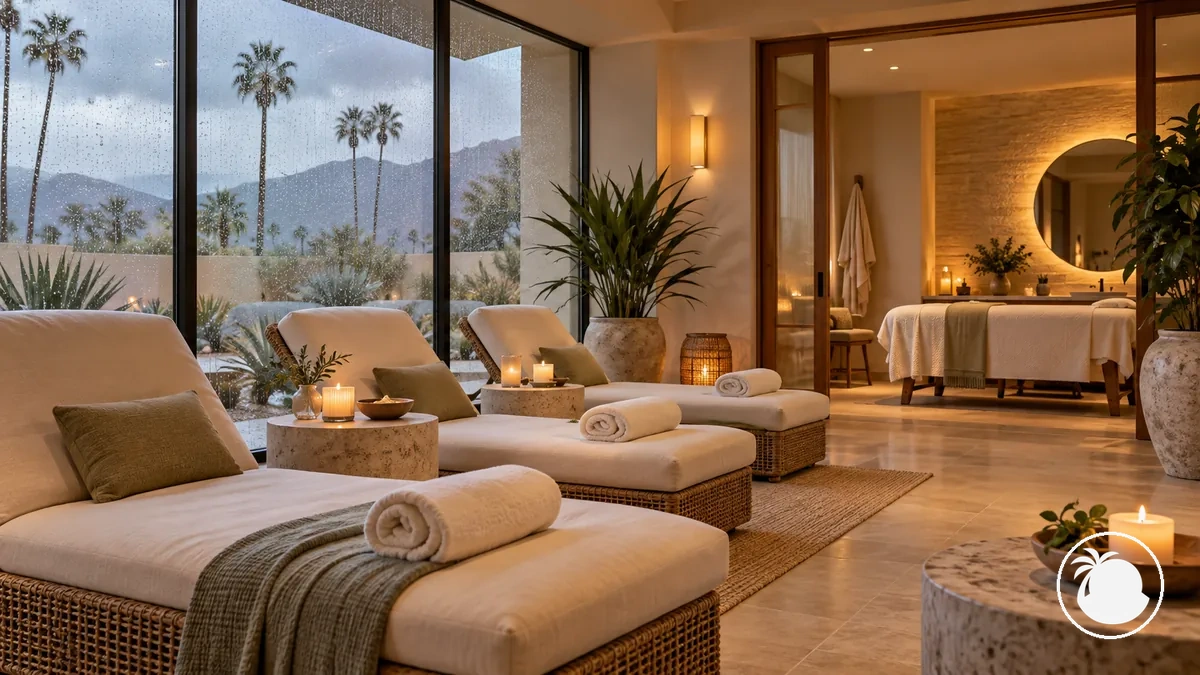
Spa and relaxation-focused indoor experiences can provide a slower-paced rainy-day alternative when the aim is to create downtime rather than fill the itinerary with active sightseeing or entertainment.
A treatment-based visit centres on a scheduled service, while a broader wellness facility may provide access to relaxation spaces or other amenities under the facility's own access conditions.
Rainy-Day Indoor Activities by Situation
Rainy-day activity suitability depends on the constraint affecting the plan. The same indoor activity can be a strong fit in one situation and a poor fit in another, so weight the criterion that is hardest to change first.
Main conditions
- Location constraint
- Give more weight to short, sheltered transitions, practical parking or drop-off, and the ability to move between indoor places without unnecessary exposure.
- Group constraint
- Give more weight to age mix, interests, supervision or participation needs, and whether the activity style fits everyone who needs to take part.
- Timing constraint
- Give more weight to verified operating hours, activity duration, booking dependence and how easily the stop can fit the remaining part of the day.
Across all three: indoor protection still matters. A venue can be indoors while arrival, parking, waiting or movement between spaces remains exposed to rain.
Indoor Activities Around Downtown Palm Springs
For a visitor already in or near downtown Palm Springs, indoor activities with closer proximity can reduce the amount of outdoor movement needed between stops during rain.
Walking distance alone does not guarantee low weather exposure, because the practical transition also depends on shelter, parking or drop-off arrangements, and the conditions at the time.
Convenience therefore depends on how much exposure occurs during each transition, whether the opening window fits the planned visit, and whether the indoor duration makes the move worthwhile.
Nearby indoor stops can be easier to combine when these factors align, but each location and its current operating conditions still require checking.
- Proximity and walking distance: shorter separation between indoor stops may reduce time outside, but the actual weather exposure depends on the route and current rain conditions.
- Parking and drop-off: access close to an entrance may limit exposure during arrival and departure, while a longer transition from parking or a drop-off point can reduce that convenience.
- Transition exposure: consider how much of the movement between stops is outdoors, because nearby locations can still require unsheltered transitions.
- Opening window: check that each stop is open during the intended period before combining nearby activities, since mismatched operating windows can make proximity less useful.
- Indoor duration: consider whether the expected time spent indoors fits the available schedule and justifies another transition through the rain.
A compact cluster of nearby indoor activities can reduce unnecessary transitions when proximity, access, operating windows, and indoor duration align, without requiring a prescribed downtown walking route.
Family-Friendly Indoor Activities During Rain
For a family with children, rainy-day indoor activity suitability changes with the children's age range, supervision needs, and ability to engage with the activity rather than creating a separate category of attractions.
Child admission alone does not establish family fit, because an activity may allow children while its participation style, session length, or activity level does not suit a particular family group.
Age range and hands-on engagement affect whether children can participate meaningfully, while supervision requirements affect how adults need to take part or monitor the experience.
Session length should fit the group's available time and engagement needs without assuming a universal attention span.
Activity level and the amount of fully indoor time also affect suitability, particularly when a family wants to limit transitions through rain.
- Age range: check whether the activity format suits the ages in the family group, because younger children, older children, and mixed-age groups may engage differently with the same option.
- Supervision: activities requiring close adult involvement may change how practical the experience is for families supervising more than one child or different age groups.
- Hands-on engagement: creative activities, bowling, indoor play, or interactive museum elements may suit children who prefer active participation, while more observational experiences depend more heavily on individual interests.
- Session length: the expected duration should match the family's schedule and the children's likely engagement with that specific activity rather than relying on a fixed attention-span assumption.
- Activity level: a more physically or socially active option may fit children seeking participation, while a quieter experience may suit a family wanting a lower-activity period.
- Indoor time: activities that keep the group fully indoors for the required period can reduce repeated weather exposure, while options involving outdoor transitions require additional consideration during rain.
Indoor Options for a Rainy Evening
When a rainy evening leaves only a limited window for indoor activities, timing becomes a stronger constraint than it is during an open-ended daytime visit.
An evening indoor option is more suitable when its operating hours, activity duration, and access conditions fit the time available, while daytime-heavy cultural options may be less compatible if their operating window has ended.
Operating hours require checking for the intended evening because availability cannot be assumed from the activity type alone.
Advance booking and activity duration affect whether entertainment or relaxation experiences can fit the remaining time, while family fit or suitability for adult groups depends on the specific experience and participation conditions.
Wet-weather access also matters because reaching an indoor venue may still involve outdoor exposure during arrival or departure.
- Operating window: favour an activity whose verified operating hours cover the available rainy evening period, rather than assuming a daytime option remains available later.
- Advance booking: an activity that requires advance booking may be less practical for a last-minute change of plans unless suitable availability can be confirmed.
- Activity duration: choose an experience whose expected duration fits the remaining evening window without requiring an unsupported assumption about session length.
- Group fit: entertainment or relaxation may suit different family groups or adult groups depending on participation requirements, pace, and the specific experience offered.
- Wet-weather access: consider the outdoor exposure involved in parking, drop-off, and reaching the entrance, because an indoor activity does not necessarily provide sheltered access from arrival to departure.
A two-hour evening window requires a more tightly timed choice than an open-ended rainy afternoon, when operating windows and activity duration may allow greater flexibility.
How to Adjust a Palm Springs Itinerary Around Rain
Adjust a Palm Springs itinerary around rain by protecting priority activities and moving or replacing weather-dependent stops rather than rebuilding the plan from zero.
The aim is to preserve each stop's purpose where possible while changing the sequence when weather sensitivity or timing makes the original order impractical.
Check the forecast for the expected timing and intensity of rain, while treating that forecast as a planning input rather than a guaranteed rain window.
For each planned stop, consider its function, weather sensitivity, reservation rigidity, and timing flexibility before deciding whether to keep, move, or replace it.
The revised plan should protect fixed reservations and priority activities while using indoor substitutes where they provide similar replacement value.
- Check the forecast: identify when rain is expected and whether conditions appear likely to affect the relevant part of the day; if timing remains uncertain, retain flexibility rather than relying on an exact weather window.
- Identify weather-dependent stops: review planned activities for outdoor exposure and determine which stops become less practical under the expected conditions before changing activities that remain workable.
- Match indoor substitutes: identify the function of each affected stop, such as cultural sightseeing, active recreation, or relaxation, and match it with an indoor substitute that serves a similar purpose when a suitable option is available.
- Protect fixed reservations and priorities: keep high-priority commitments and fixed reservations in place when feasible, and verify any change before assuming a reserved activity can be moved.
- Verify the revised sequence: reorder flexible stops around the protected commitments, then check travel feasibility, operating conditions, timing flexibility, and the sequence before relying on the revised plan.
For broader three-day itinerary planning, keep the overall trip structure separate from this rainy-day adjustment.
For example, if rain affects only part of a day, an outdoor priority activity can remain in a more suitable period while a weather-dependent stop in the affected period is replaced by a functionally similar indoor activity, preserving the main priorities without rebuilding the entire itinerary.
Replacing Weather-Dependent Outdoor Attractions
Replace a weather-dependent outdoor attraction by matching its activity function to an indoor substitute that preserves the original purpose where practical, rather than choosing an unrelated activity simply to fill time.
The replacement does not need to reproduce the outdoor experience exactly; it needs to support a similar goal, such as sightseeing, culture, family activity, recreation, or downtime.
A workable indoor substitute should fit the available time window and location closely enough to remain practical within the existing itinerary.
Reservation needs and the time required can determine whether the replacement can occupy the displaced stop's original period.
Group fit also matters because an indoor alternative that preserves the activity function for one group may not suit another group's ages, interests, participation needs, or preferred pace.
- Sightseeing → indoor observation or exhibition: when the outdoor goal is to see and understand a place or subject, an indoor exhibition or interpretive attraction may preserve the sightseeing function if its location and time requirement fit the same itinerary window.
- Culture → museum, gallery, or cultural exhibition: when the displaced stop is primarily cultural, an indoor cultural venue can preserve the focus on art, history, or local culture when its access conditions and visit length fit the revised plan.
- Family activity → participatory indoor activity: when shared engagement is the main goal, a hands-on creative activity, indoor play option, or other participatory experience may fit if its group requirements, duration, and reservation conditions suit the family.
- Active recreation → indoor recreation: when the outdoor attraction was intended to provide active participation, an indoor recreational activity may preserve that function if the activity level, group fit, location, and available session timing align.
- Downtime → indoor relaxation: when the original stop was intended to provide a slower period, a sheltered relaxation or wellness experience may preserve that purpose if its reservation needs and time commitment fit the available window.
For example, replacing outdoor cultural sightseeing with an indoor cultural exhibition preserves the original activity function more closely than inserting an unrelated recreation session solely because it is indoors.
Reordering Flexible Indoor Stops Around the Forecast
Flexible indoor stops can be moved into the likeliest rain window while fixed activities or weather-sensitive stops remain in more suitable periods when practical.
Because forecast timing can shift, preserve flexibility rather than depending on rain starting or ending at an exact time.
Use the forecast to identify the likely wettest window, then consider reservation rigidity before deciding which stops can move.
Travel time and indoor duration affect whether a flexible stop can occupy the new position without creating unnecessary disruption elsewhere in the sequence.
Seasonal weather guidance can provide broader context, but the current forecast remains the relevant input for a specific day's ordering.
After any change, recheck operating conditions and the revised sequence because both forecast timing and practical access may change.
- Identify the likely rain window: use the current forecast to locate the period most likely to be affected, while keeping adjacent periods flexible if the timing shifts.
- Separate fixed and flexible stops: treat activities with fixed reservations or limited timing flexibility as constraints, and identify flexible indoor stops that can potentially move without conflicting with those commitments.
- Move suitable indoor stops: place a flexible indoor stop within the likely wet window when its reservation requirements, indoor duration, and location allow it to fit without creating a larger scheduling problem.
- Recheck travel time and sequence: verify that the revised order remains practical for travel time, operating conditions, and fixed commitments, and adjust again if the forecast or access conditions change.
If rain is concentrated in the morning, a flexible indoor stop can move earlier while a weather-sensitive activity remains later when conditions appear more suitable.
If the likely rain window shifts to the afternoon, the same activities can be reordered in the opposite direction, provided reservation rigidity, travel time, and operating conditions still allow the change.