
Do You Need a Car in Palm Springs?
You do not always need a car in Palm Springs. A car is most useful when your itinerary has several dispersed stops, trailheads or outlying attractions with poor non-driving access, or a strong need for flexible timing; a centrally located stay with clustered activities can often work with walking plus occasional rideshare or SunLine service when the relevant routes and schedules fit your plans.

Car decision at a glance
Match your itinerary to the pattern that best describes how you will move around Palm Springs.
A car is more useful when
- You have several separated stops in the same day.
- You need trailheads or outlying attractions with an inconvenient last-mile connection.
- Flexible departure times or carrying items between stops matter to your plan.
You can often go without one when
- Your accommodation is close to most planned activities.
- Your stops are clustered in or near downtown and only a few longer trips are needed.
- Walking, rideshare or current SunLine routes cover the remaining journeys comfortably.
Check before deciding
- Actual routes, current transit schedules and walking connections.
- Rideshare availability at the times you expect to travel.
- Destination access, parking rules, weather and individual mobility needs.
No single trip length or stop count decides the issue. The practical question is whether your daily movement is concentrated enough for the alternatives to work without creating too much waiting, walking or coordination.
Use the overview above as a first-pass decision, then check the factors and transport modes below against the exact stops in your itinerary.
Table of Contents
Key Factors in Choosing How to Get Around Palm Springs
Transport decision criteria in Palm Springs come down to a small set of trip conditions: accommodation location, attraction distance, trip duration, daily stops, and whether you need to reach outlying destinations.
These conditions determine how practical walking, driving, or another form of local travel is for your movement pattern.
The criteria work together rather than independently.
A downtown stay with concentrated stops can reduce transport demand, while greater distances combined with several daily stops can increase the usefulness of driving and the need for schedule flexibility.

Five factors that change the car decision
- Accommodation location: Staying close to the places you plan to visit reduces repeated travel and can make walking more practical; staying farther from those places increases transport demand.
- Attraction distance: A compact cluster of nearby destinations supports shorter trips between stops, while dispersed attractions increase travel time and can make driving more useful.
- Downtown versus outlying destinations: Plans concentrated around downtown can favour walking for nearby stops, while reaching outlying destinations can increase the practical value of driving or another suitable transport option.
- Trip duration: A shorter stay with concentrated plans creates less repeated travel, while a longer stay that spreads activities across more locations can increase the value of flexible transport.
- Daily stops: A small number of nearby stops reduces the need to move repeatedly, while several separated daily stops increase transport demand and make schedule flexibility more important.
Taken together, these criteria show whether a visitor's movement pattern is concentrated enough for limited driving or dispersed enough to make a car more useful.
Accommodation Location and Daily Travel
Accommodation location changes transport dependence mainly through proximity. The closer your stay is to places you visit repeatedly, the less travel you need between lodging and activities.
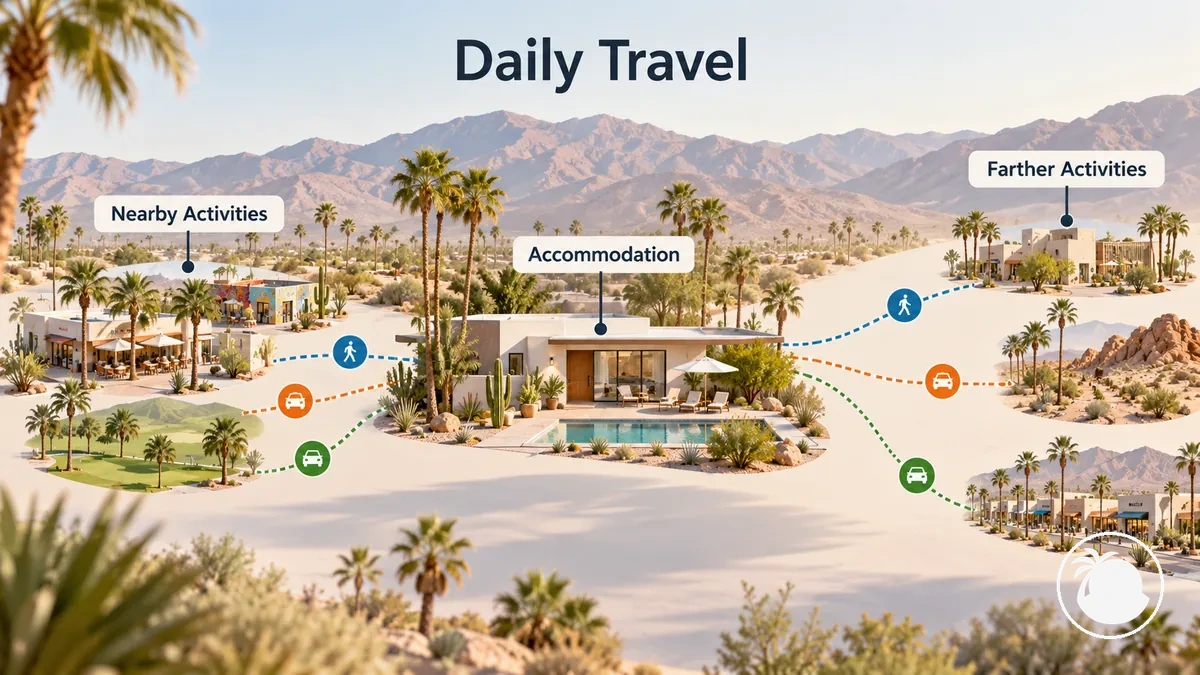
How location changes transport demand
- Closer to planned activities
- Daily journeys are usually shorter, more trips may be practical on foot, and occasional rideshare can cover gaps.
- Farther from priority activities
- Travel between lodging and each stop grows, increasing reliance on a vehicle or another transport mode.
- Returning to your accommodation during the day
- Greater separation can multiply repeated journeys, so location matters more than it would on a one-direction sightseeing day.
Distances Between Your Priority Attractions
The distance between your priority attractions matters because attraction spread determines how much travel separates one planned stop from the next, not because any single distance creates a universal transport rule.

What attraction spacing changes
Clustered stops
Shorter movements can make walking practical for more of the day when the actual route and conditions are suitable.
Dispersed stops
Longer or repeated journeys increase reliance on rideshare, transit where routes and schedules fit, or driving.
No fixed distance threshold
Judge the real route between stops, not straight-line distance alone; road, walking and transit networks determine how the journey works in practice.
Length of Stay and Number of Daily Stops
A short stay with a few concentrated daily stops can keep transport demand relatively low because fewer repeated trips need to fit into the schedule.
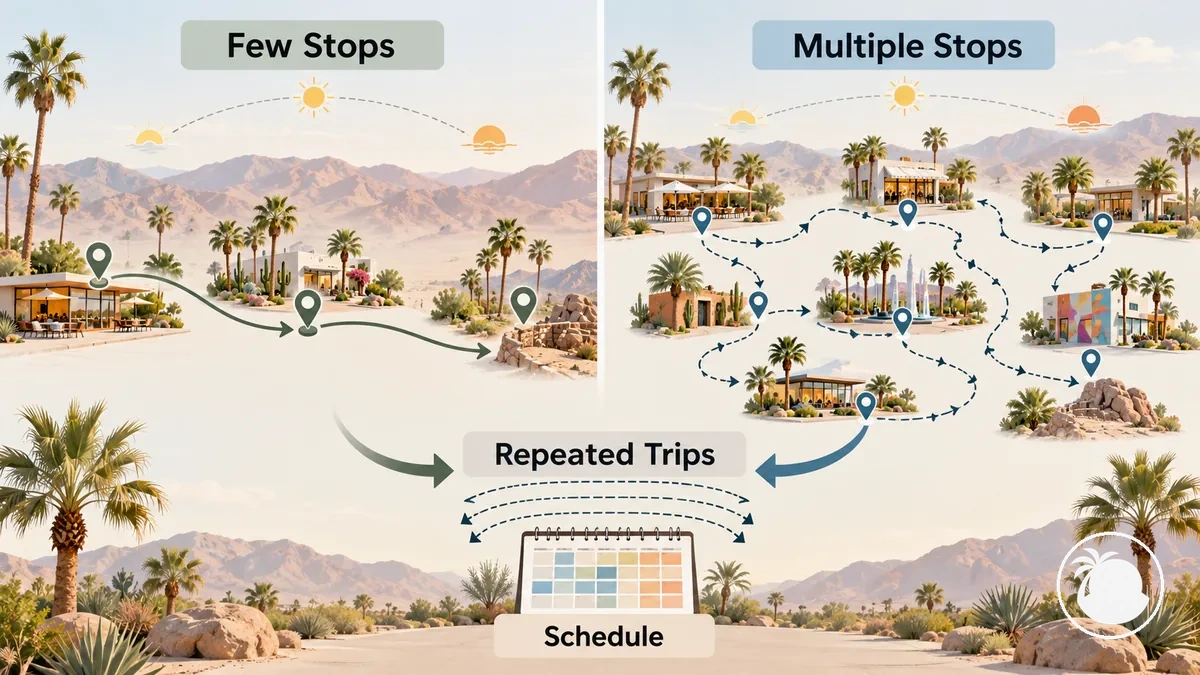
Few clustered stops vs several separated stops
Few, concentrated stops
Transport demand stays lower, so walking or other non-driving modes can work when they fit the planned journeys.
Several, separated stops
Repeated journeys create more waiting, schedule and service coordination; driving becomes more useful when flexible timing matters.
Decision boundary: trip length and stop count work together. No specific number of stops automatically requires a car.
Driving vs Rideshare, Public Transit, and Walking
Driving, rideshare, public transit, and walking solve different local transport needs in Palm Springs.
A consistent comparison looks at geographic reach, flexibility, schedule dependence, walking burden, and friction from parking, waiting, or transfers.
The suitable trip pattern for each transport mode depends on how those trade-offs match the visitor's plans rather than on one mode being universally preferable.
Driving prioritises flexible movement across multiple stops, rideshare provides point-to-point travel without parking, public transit depends on route and schedule fit, and walking is most practical when planned stops are close enough and conditions suit travel on foot.

| Transport mode | Geographic reach | Flexibility or schedule dependence | Main friction | Suitable trip pattern |
|---|---|---|---|---|
| Driving | Supports travel beyond a compact walking area and movement among multiple stops | Flexible departure timing within road and access conditions | Parking and driving conditions | Multi-stop plans where flexible departure times are useful |
| Rideshare | Point-to-point reach where service is available | Flexible request timing, with pickup and waiting dependent on availability | Waiting and service availability | Lower-stop plans where point-to-point travel suits the planned movements |
| Public transit | Destinations served by available routes and connections | Dependent on routes, schedules, and required transfers | Waiting, transfers, and walking connections | Trips where route coverage and service times align with planned stops |
| Walking | Nearby destinations that can be reached practically on foot | No vehicle schedule or parking requirement | Distance, weather, and physical effort | Concentrated plans where proximity and conditions make walking practical |
The practical mechanics of each mode depend on its specific operating conditions and are examined separately in the child subsections.
Driving for Flexible, Multi-Stop Sightseeing
Driving becomes more useful for multi-stop sightseeing when separated stops or time-sensitive sequencing make route flexibility important.
A car allows direct control over the order and timing of movements between stops instead of requiring each leg to fit another transport service or connection.
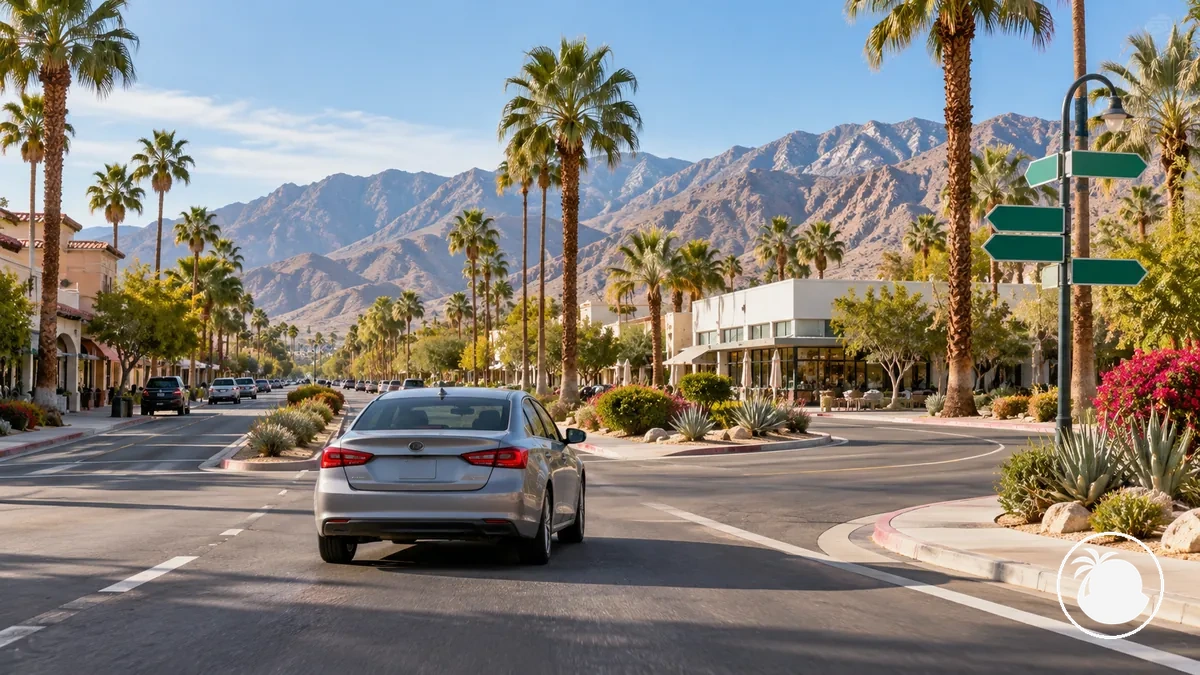
For example, a day involving several separated destinations can make driving useful because the visitor can move directly from one stop to the next, reducing coordination dependence on waiting or transfers.
Car travel also provides carrying capacity for items kept between stops, while parking, traffic, heat, and driver preference can offset some of that convenience.
Driving therefore provides a suitable context for dispersed sightseeing when route control and multi-stop coordination matter, without being necessary for every visitor or attraction.
Rideshare for Occasional Point-to-Point Trips
Rideshare can substitute for having a car when you need only occasional point-to-point trips within a low-stop itinerary.
When rideshare fits best
Occasional rides
Point-to-point convenience can outweigh waiting and availability uncertainty when only a small number of journeys need coordination.
Repeated daily rides
Every extra trip adds another pickup wait and another paid fare, so cumulative cost and coordination become more important.
Rideshare pickup timing is not guaranteed; suitability depends on service availability when you actually need to travel.
Public Transit When Routes Fit Your Plans
Public transit is workable when route coverage, service timing, transfers, and walking connections align with the destinations in a visitor's trip plan.
For Palm Springs trips using SunLine, suitability therefore depends on the specific route and schedule serving each planned journey rather than on the existence of local bus service alone.
Check all four parts of a SunLine trip
- Route coverage: does transit connect the destinations you actually need?
- Service timing: do current schedules provide enough flexibility for your planned arrival and departure times?
- Transfers: will a connection add waiting or another schedule dependency?
- Walking connection: is the distance between the stop and destination practical for you and the conditions?
Routes, service frequency and schedules can change, so verify current SunLine information for the specific journeys in your itinerary.
Walking for Downtown and Nearby Plans
Walking is most practical for concentrated downtown or nearby plans when the required movement stays within a manageable distance for the visitor.
What changes walking practicality
- Stop spacing
- Closer stops support more walking; dispersed stops increase both distance and travel time on foot.
- Weather
- Hot conditions can reduce walking comfort even when a route is geographically close.
- Mobility and walking tolerance
- The same route can be practical for one visitor and unsuitable for another.
- Cumulative distance
- Several individually manageable walks can still create a larger physical and time burden across the whole day.
When a Car Matters More for Trailheads and Outlying Attractions
A car generally becomes more useful when a Palm Springs trip includes trailhead access or outlying attractions with limited non-driving alternatives or an inconvenient last-mile connection.
Some closer destinations may still be reachable without driving, so the transport requirement is destination-specific rather than a rule that every trail or outer attraction requires a car.
Use the required access point, not the attraction name, to decide
- Identify the real access point — for example, the trailhead, entrance or parking area you must actually reach.
- Check the last mile — can transit, rideshare or a reasonable walking connection get you there at the required time?
- Choose by the connection — if the non-driving connection is practical, a car may be optional; if it is not, a car becomes more useful.
Access can vary by destination, road, parking area and service availability, so verify current destination-specific conditions before treating driving as necessary or optional.
When a Short Palm Springs Stay Can Work Without a Car
A short stay in Palm Springs can work without a car when central accommodation keeps planned activities concentrated and only a few longer trips are needed.
Car-free feasibility becomes weaker when the visit includes repeated travel to dispersed destinations.
The practical decision depends on how the trip conditions affect walking and reliance on rideshare or public transit:
- Central accommodation: Staying near planned activities supports compact sightseeing because more stops may be reachable on foot.
- Compact sightseeing: Keeping activities within a concentrated area reduces the amount of transport needed between stops.
- Low stop count: Fewer separated journeys limit the number of times a visitor needs rideshare, public transit, or another transport option.
- Alternative-mode dependence: A car-free stay is more workable when available rideshare or public transit fits the journeys that are not practical on foot.
- Dispersed destinations: Repeated trips between widely separated locations increase transport dependence and can make a car more useful even during a short visit.
A short visit can therefore still benefit from a car when its planned destinations are widely separated or require repeated travel that does not fit the available alternatives.
The decision is whether the specific short-stay pattern can function without a car, rather than whether every short Palm Springs visit is inherently car-free.
How Parking Availability and Time Limits Affect the Car Decision
Parking is location-specific in Palm Springs. Availability, parking location and posted time limits can differ by the space or destination, so they should be checked where you actually plan to stop.
Parking matters to the car decision when it creates friction with your itinerary: a posted time limit shorter than your planned stop can require moving the vehicle or changing the visit, while a nearby space without a conflicting restriction removes that particular problem.
The practical checks are:
- Parking availability: Check whether parking is available near the planned stop; greater search or walking effort can reduce driving convenience.
- Posted signs: Check the rules that apply to the specific space instead of assuming that downtown parking follows one universal condition.
- Time limits: Compare any posted limit with the expected stop duration; a conflict can require vehicle movement or a change to the stop sequence.
- Parking location: Distinguish public downtown parking from destination-specific or private-property parking, where different rules may apply.