
Things to Do in Palm Springs on a First Visit
For a first visit to Palm Springs, choose a small number of distinctive attractions that match your interests, then test them against available time, travel overhead, physical effort and current access conditions. Culture, midcentury architecture, and desert or mountain scenery are the main sightseeing choices; the best mix is the one that fits both what you want to experience and what your visit can comfortably support.
Choose attractions by interest, then feasibility
Start with the Palm Springs experience you most want, then use practical filters to decide what deserves limited first-visit time.
- Distinctiveness + interest
- Higher priority when the experience feels strongly connected to Palm Springs and closely matches what you want from the visit.
- Time + travel overhead
- When time is tight, favour attractions that cluster efficiently; a separated sight needs enough value to justify its own travel block.
- Effort + access
- Walking, terrain, reservations, operating status and other access conditions can lower practical priority even when an attraction is appealing.
Decision rule: prioritise attractions that are high in personal relevance and Palm Springs distinctiveness and still fit the practical limits of the visit. Popularity alone is not a reliable selection rule.
Location changes feasibility rather than inherent attraction value: central sights are often easier to combine, while outlying sights can still deserve priority when their distinctiveness justifies the extra time or effort.
Table of Contents
How to Prioritise Palm Springs Attractions on a First Visit
For a first visit, Palm Springs attraction priority should start with destination distinctiveness and personal interest, then be tested against available time and practical effort.
An attraction that strongly reflects Palm Springs or closely matches your interests can deserve higher priority, but that priority falls when travel overhead, physical effort, or opening constraints make it a poor fit for the time available.
Popularity alone is therefore not a reliable selection rule.
The criteria below separate value from feasibility so you can judge why an attraction deserves scarce sightseeing time and whether it realistically fits your visit.
The accompanying illustration represents the balance between interest and practical constraints without assigning a universal winner.

- Value — destination distinctiveness: Give greater priority to an attraction when its cultural value, architecture, or desert setting provides an experience closely associated with Palm Springs; give it less weight when a similar experience is readily available elsewhere on your trip.
- Value — personal interest: Prioritise attractions that match what you actually want from the visit, because a highly distinctive sight can still be a lower priority when its subject has little relevance to your interests.
- Feasibility — available time: Compare the attraction's likely time commitment with your time budget. When time is scarce, sights that can be experienced without consuming most of the available sightseeing period become easier to prioritise.
- Feasibility — travel overhead: Weigh the effort of reaching an attraction against the experience itself. A more distant sight can fall in priority when getting there would displace other experiences that better fit a short visit.
- Feasibility — physical effort: Consider how much walking or other exertion an attraction involves relative to the visitor's preferences and capabilities; greater effort should lower priority when it conflicts with how the visitor wants to spend the day.
- Feasibility — opening constraints: Treat operating hours, reservations, or other access conditions as practical filters when they apply. An attraction becomes a lower priority for a particular period if it cannot be visited within the available window.
- Feasibility — attraction cluster: Give compatible nearby sights more weight when they can be combined with less travel overhead, particularly when the time budget is tight.
A visitor with only a few hours may therefore favour a distinctive attraction that matches a strong personal interest and can be combined efficiently with nearby sightseeing.
With most of a day available, an attraction involving greater travel overhead or physical effort can move higher in priority if it offers greater personal or destination-specific value.
These criteria determine what deserves time; the order in which selected attractions are visited is a separate itinerary-sequencing task.
Palm Springs Attractions by Interest
Palm Springs attractions can be grouped by the sightseeing interest they satisfy: cultural sights and museums, midcentury modern architecture, and desert, canyon, or mountain experiences.
Each attraction category has different defining subject matter, from art and heritage to built design and natural scenery.
For a first visit, this classification helps visitors identify which type of sightseeing most closely matches what they want to experience.
These categories represent parallel reasons to sightsee rather than stages of an itinerary, and no category is inherently the preferred choice.
The comparison graphic distinguishes the three interests visually, while the list identifies the subject matter and visitor interest associated with each category.
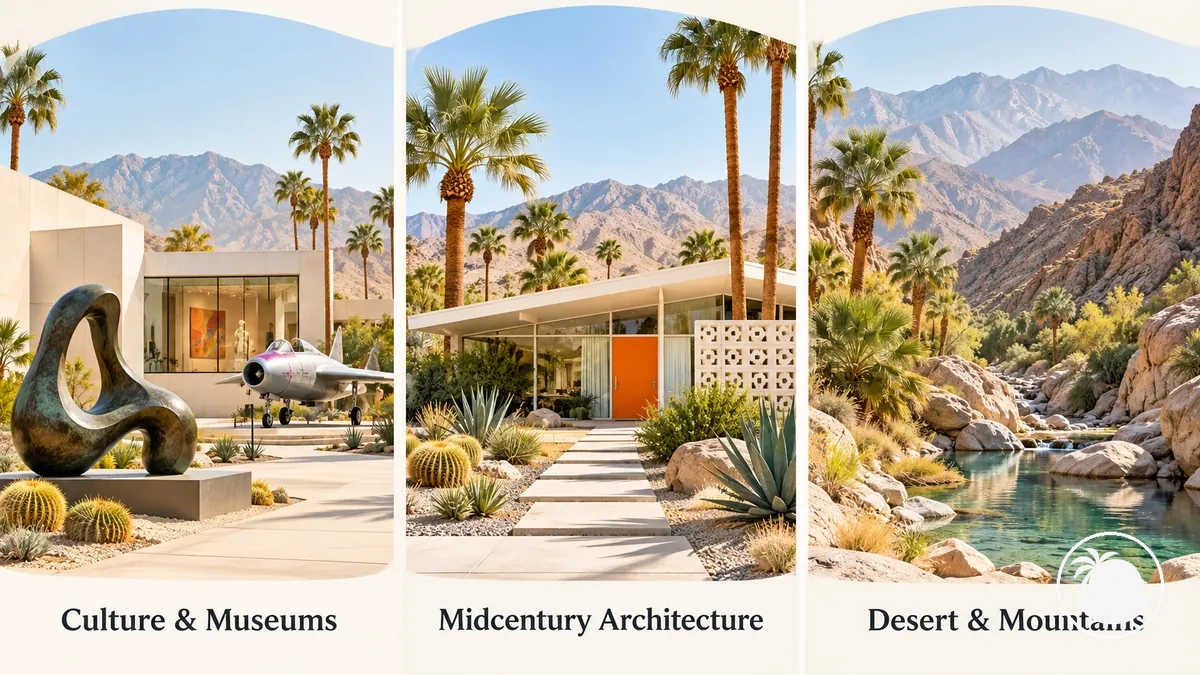
- Culture and museums: This category centres on art, cultural heritage, museums, and aviation, making it relevant to visitors whose interest is understanding Palm Springs through its collections, history, and cultural subjects.
- Midcentury modern architecture: Architecture sightseeing highlights desert modernism, design, and the built form of Palm Springs, appealing to visitors interested in how midcentury ideas shaped the city's visual character.
- Desert, canyon and mountain attractions: These sights focus on the desert landscape, canyon environments, mountain scenery, and outdoor settings, fitting visitors whose sightseeing interest is primarily the natural setting around Palm Springs.
Individual attractions and representative examples remain subordinate to these three interest categories and can be considered within their respective detailed sections.
Museums and Cultural Sights
Palm Springs museums and cultural sights are most useful to a first visit when their collection focus matches the visitor's interest.
Art and design, Indigenous history and local history, and aviation each provide a different cultural perspective, so the subject interpreted by an institution matters more than simply choosing the nearest venue.
Current access conditions can also affect suitability, but they are a secondary filter after collection fit.
Three representative institutions make these differences concrete.
Palm Springs Art Museum describes a collection spanning modern and contemporary art, architecture, and design; Agua Caliente Cultural Museum presents the culture and history of the Agua Caliente People; and Palm Springs Air Museum focuses on aviation through aircraft, artefacts, and exhibits related to U.S. military aviation history.
The image illustrates the cultural-venue context, while the grouping below separates the institutions by the interests they serve.
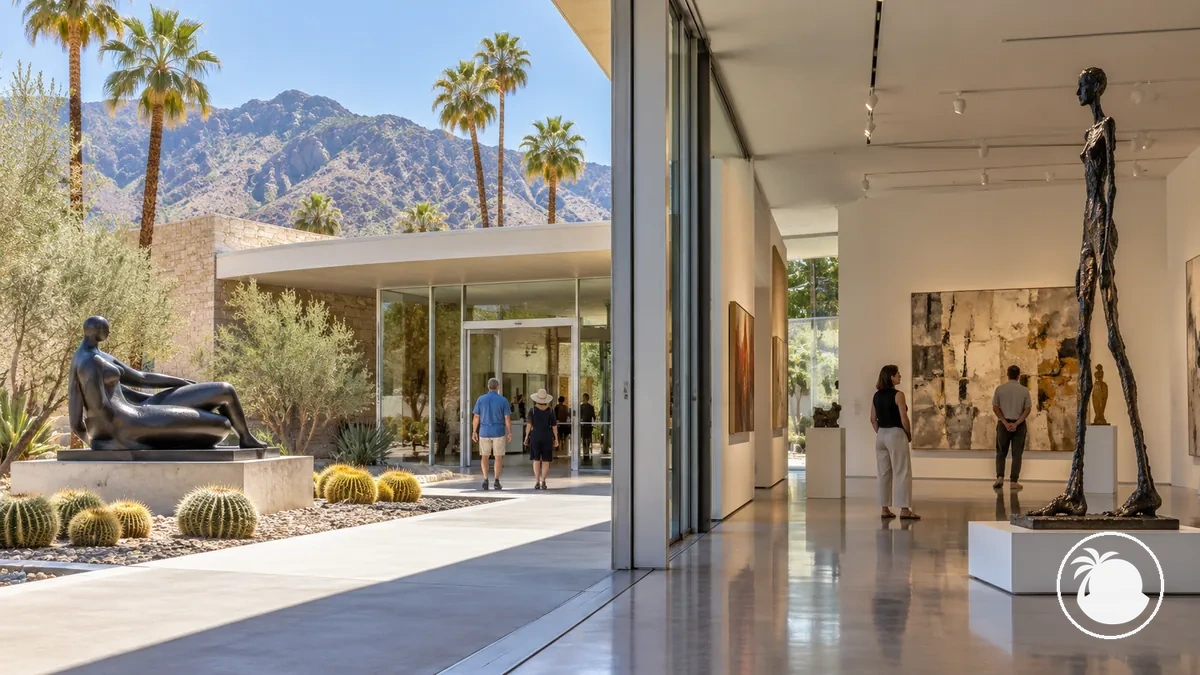
- Palm Springs Art Museum — art and design: Its collection focus includes modern and contemporary art, architecture, and design, so it may suit visitors who want visual art and design to shape the cultural part of their first visit.
- Agua Caliente Cultural Museum — Indigenous and local history: Its cultural focus interprets the Agua Caliente People, including Cahuilla identity, ancestral lands, material culture, and Tribal history, making it relevant to visitors seeking an Indigenous perspective on the Palm Springs area's history and culture.
- Palm Springs Air Museum — aviation and regional heritage: Its museum focus combines aircraft, artefacts, and exhibits related to U.S. military aviation history, which may suit visitors whose interest centres on aviation and its historical context. Because operating hours and closures can change, current access should be confirmed for the intended visit date.
For a first visit, choose among these cultural venues primarily by collection focus and the subject you want to understand, then use available time and current access conditions to confirm suitability rather than selecting a museum merely because it is nearby.
Midcentury Modern Architecture
Palm Springs midcentury modern architecture is a distinctive sightseeing interest because desert modernism adapted modernist design to the city's desert setting and made the relationship between buildings, landscape, shade, and outdoor living visually prominent.
Visitors can recognise this architecture through features such as low horizontal forms, expressive rooflines, indoor-outdoor design, and patterned breeze blocks.
These characteristics make the architecture itself a sightseeing subject rather than simply a backdrop to other attractions.
From a public-facing view, visitors can look for these visible design features in individual buildings and residential neighbourhoods without treating the experience as a route or assuming that a notable exterior can be entered.
Low building profiles, distinctive rooflines, glazing, shaded transitions to outdoor space, and breeze blocks can all help identify the design language from appropriate public viewpoints.
The photo illustrates these exterior attributes, while the feature list identifies what each characteristic can reveal.
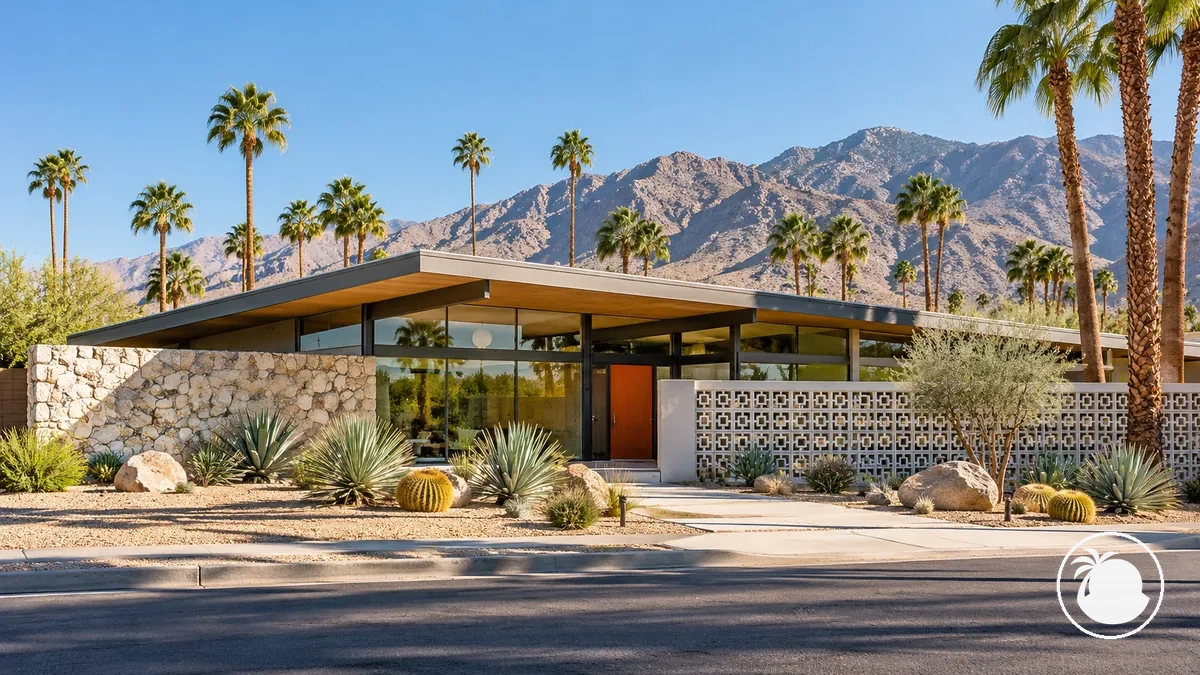
- Low horizontal forms: Long, low building profiles emphasise horizontal lines and help visitors recognise the restrained massing associated with much midcentury design.
- Rooflines: Flat, low-pitched, or more expressive roof forms can become prominent parts of a building's silhouette, giving visitors an immediately visible architectural feature to compare across different examples.
- Indoor-outdoor design: Large areas of glazing, patios, overhangs, and visual connections between living spaces and the surrounding landscape can show how desert modernism connects buildings with their outdoor setting.
- Breeze blocks: Patterned masonry screens can provide shade, filtered light, partial screening, and visual texture, making them a recognizable exterior detail where they are present.
- Residential neighbourhoods: Concentrations of midcentury homes allow visitors to notice how recurring forms, rooflines, landscaping, and other design features vary between properties while observing from public streets or other appropriate public-facing viewpoints.
Publicly visible architectural features can be appreciated from appropriate public-facing viewpoints, but an external view of a private home does not imply permission to enter the property.
Desert, Canyon and Mountain Attractions
Palm Springs natural attractions differ in suitability for a first visit mainly according to terrain, exposure, physical effort, time commitment, and current access conditions.
Desert and canyon settings can involve walking over natural terrain and greater exposure to outdoor conditions, while mountain sightseeing can involve transport to higher elevations followed by anything from scenic viewing to additional walking.
The practical choice therefore depends on how much effort and time a visitor wants to commit and on the conditions in effect on the visit date.
Indian Canyons and Tahquitz Canyon represent canyon environments where experiencing the landscape involves more walking and terrain engagement than viewing scenery from a roadside or developed viewpoint.
Tram-accessed high country changes the setting again: the Palm Springs Aerial Tramway provides the transport component, while any activity after arrival depends on what the visitor chooses to do and on current mountain conditions.
The photo illustrates how visible terrain and environmental scale help explain these differences, while the list separates representative settings by their practical requirements.
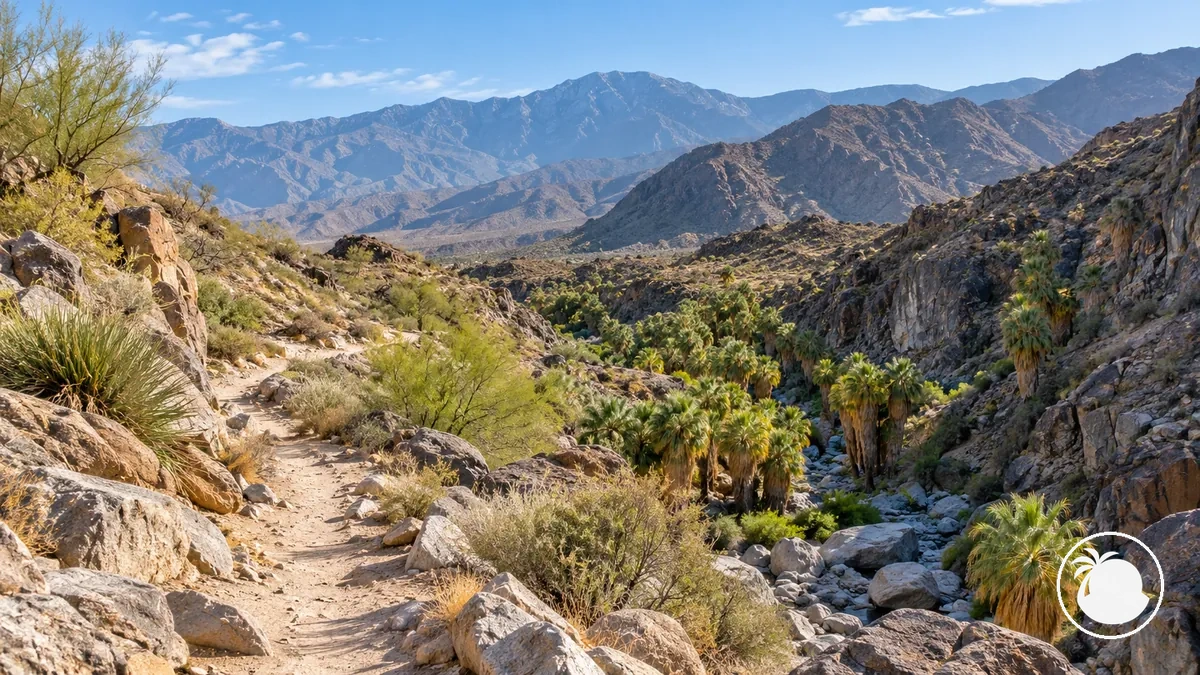
- Low-effort scenic viewing: Desert or mountain viewpoints that can be appreciated with limited walking may suit a first visit when the priority is scenery without committing substantial time or physical effort; the actual access conditions depend on the chosen location.
- Indian Canyons: The canyon setting includes trails through desert and palm-oasis terrain, so a visit that goes beyond initial scenic observation requires walking and greater exposure to outdoor conditions.
- Tahquitz Canyon: Experiencing the canyon beyond its visitor facilities involves trail walking over natural terrain, making physical effort and available time more important selection criteria than they are for primarily viewpoint-based sightseeing.
- Tram-accessed high country: The Aerial Tramway changes the access condition by transporting visitors into a mountain environment, but time commitment and physical effort after arrival depend on whether the visitor limits the experience to developed viewing areas or continues into outdoor activities.
Season, temporary closures, individual fitness, trail conditions, and operating status can change the suitability of these attractions, so current conditions should be checked before committing time to a particular natural setting.
Detailed transport, operating, and high-country decisions belong to Aerial Tramway visit planning rather than this attraction comparison.
Choosing Attractions by Location and Travel Time
Palm Springs attraction location can raise or lower practical priority on a first visit because geographic clustering can reduce travel overhead between sights.
An attraction within a central Palm Springs cluster may be easier to combine with other stops, while a separate location can require a larger time block for the drive, arrival, and return.
Actual travel time remains conditional because traffic, parking, and route choice can change the movement burden.
The main location criteria are how closely attractions cluster, how much transfer effort separates them, and whether a sight can be combined with other planned stops without creating a separate trip.
The diagram illustrates central clustering versus separate locations without assigning exact distances or travel times.
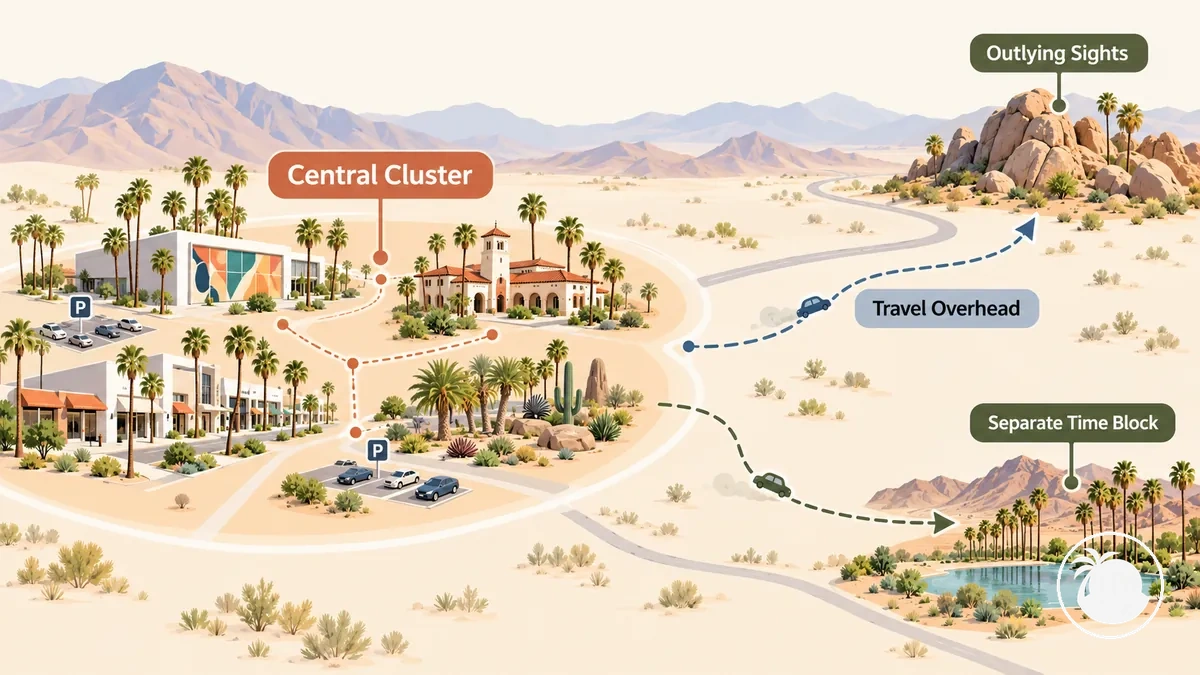
- Cluster density: A concentration of sights in central Palm Springs or downtown can reduce the number of separate transfers needed, making individual attractions more practical to include when several points of interest occupy the same general area.
- Transfer burden: An attraction separated from the main sightseeing cluster adds movement between locations, so the additional travel overhead can lower its practical priority when available sightseeing time is limited.
- Parking or arrival friction: Where reaching and entering an attraction involves additional parking or arrival effort, that friction adds to the time commitment beyond the attraction visit itself; the effect depends on conditions at the time of the visit.
- Ability to combine sights: Geographic proximity can make a lower-priority attraction practical when it can be combined with other sights in the same attraction cluster without substantial additional movement.
- Separate time block: A sight that requires a distinct drive or lies apart from the central cluster may need deliberate scheduling as its own time block, particularly when traffic, parking, or route conditions add further variability.
For example, a visitor considering several sights within a central Palm Springs or downtown cluster can evaluate them as a shared geographic block rather than as separate transfers.
An attraction outside that cluster may still deserve time, but the drive and associated travel overhead can make it more practical to treat as a separate local trip block.
This location-based comparison helps determine whether proximity improves an attraction's fit without prescribing a route or assuming fixed travel times.
Downtown and Central Palm Springs Sights
For a first visit focused on several sights in a compact area, downtown and central Palm Springs can reduce movement between separate stops. The benefit is logistical: proximity can make different experiences easier to combine without making every central attraction equally important.
Sights Beyond Central Palm Springs
Unlike sights clustered in central Palm Springs, an outlying attraction can require a separate time block. Its practical value depends on the experience it adds relative to the total travel and visit time it displaces.
Local sightseeing or separate excursion?
Still local sightseeing
An attraction elsewhere in the Palm Springs area or Coachella Valley can still fit the visit when its distance, access and visit duration fit comfortably within the sightseeing time available.
Separate excursion
A farther destination increasingly functions as an excursion when reaching and experiencing it displaces a substantial share of the time otherwise available in Palm Springs. Joshua Tree is a clear example of this separate planning context.
Decision rule: do not use a fixed distance threshold. Weigh the attraction's distinctiveness against its combined travel, access and visit commitment; a farther sight can still be worthwhile when the added experience justifies that separate block of time.
Self-Guided Ways to Explore Palm Springs Sights
Self-guided Palm Springs sightseeing works best when walking, driving, or audio-assisted exploration matches the sight type, spatial dispersion, navigation burden, available time, and preferred pace.
Walking can fit compact sights that can be connected through public access, while driving can fit architecture and neighbourhoods spread across a wider area.
Audio-assisted exploration can support visitors who want narration while moving independently, but its practical fit still depends on the route, navigation requirements, and the visitor's pace.
The comparison below distinguishes the three self-guided methods by best-fit sights, movement or navigation need, time commitment or pace, and their main limitation.
These are method-selection differences rather than rankings, so the suitable approach changes with the sights a visitor wants to experience and the amount of independent navigation involved.
| Method | Best-fit sights | Movement or navigation need | Time or pace implication | Main limitation |
|---|---|---|---|---|
| Walking | Compact downtown sights, public art, history, and other closely grouped points of interest | Requires pedestrian navigation between publicly accessible locations | Supports a visitor-controlled pace but becomes less practical as sights become more dispersed | Distance, conditions, and public access can limit which sights can reasonably be combined on foot |
| Driving | Dispersed architecture, neighbourhoods, and sights separated across a wider area | Requires road navigation plus appropriate stopping or parking where available | Can connect dispersed sights more efficiently, although travel and stopping requirements add variable time | Viewing from a public street does not provide access to private property, and stopping opportunities vary by location |
| Audio-assisted exploration | Sights where independent movement benefits from accompanying historical, architectural, or cultural narration | Requires following the relevant audio content while navigating independently | Can support a flexible pace when the audio format allows independent progression, but total time still depends on movement and stopping choices | Navigation remains the visitor's responsibility unless the particular audio service explicitly provides navigation support |
Each self-guided method has limits that become more important as routes grow less compact or sightseeing involves residential areas.
Walking and driving both require visitors to judge navigation and time commitment according to current conditions, while audio-assisted exploration does not remove those practical requirements unless a particular service explicitly supports them.
Public access should remain the boundary for architecture and neighbourhood sightseeing: viewing a building from an appropriate public location does not imply permission to enter private property.