
Choosing Where to Stay in Palm Springs for a Short Visit
For a short visit, choose Downtown Palm Springs when walkability to restaurants, shops, galleries, and central activity is the main priority. Choose Uptown Palm Springs for walkable local activity in a different central setting, or a quieter residential or resort-style area when calm, space, separation, or on-site amenities matter more and additional transport is acceptable. If you will not have a car, prioritise the exact property’s practical walking access over the neighbourhood name.

Quick area selector
Match the area to your short-stay priority
Choose the factor that matters most, then indicate how flexible your transport plan is. The result is a starting point; verify the exact property location before booking.
Best starting point
Downtown Palm Springs
Start with Downtown when routine meals, shops and central activity need to be reachable on foot. A suitably located part of Uptown can also work if the property has practical walking continuity to the places you expect to use.
Verify: the walking route from the exact property to several useful destinations, not just one nearby venue.
Use the area name as a first filter, then check the property’s immediate surroundings. Centrality is most valuable when it removes repeated daily transport; calm and space are most valuable when they match how you plan to spend the stay.
Table of Contents
How to Compare Palm Springs Areas for a Short Stay
Comparison criteria for Palm Springs accommodation areas should focus on location conditions that materially affect a short stay, especially everyday access, atmosphere, space, and transport dependence.
Area suitability changes according to how well those conditions match traveller priorities.
The criteria should not be weighted equally for every traveller: someone prioritising walkability to restaurants and shops may assess the same location differently from someone prioritising quiet or a resort atmosphere.
The following criteria organise the main location attributes that affect day-to-day convenience and stay quality.
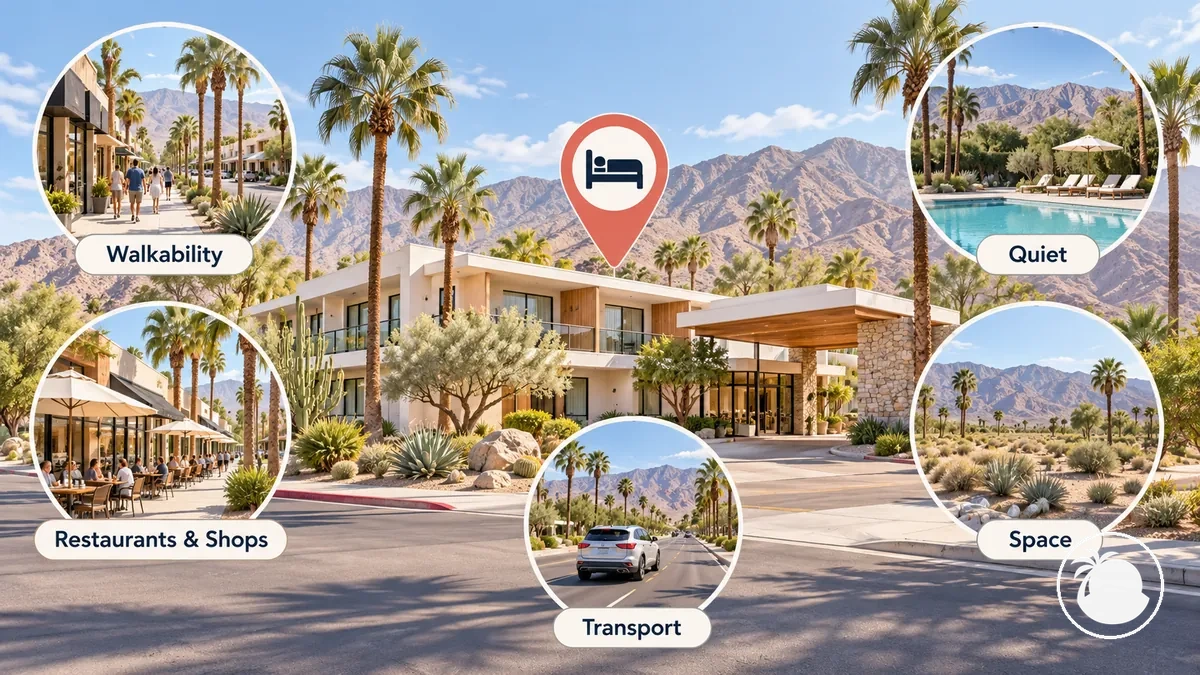
- Walkability to restaurants and shops: If useful dining, shopping, and everyday stops are accessible on foot from the accommodation, daily movement can require less transport planning during a short stay. If those destinations are dispersed from the property, convenience becomes more dependent on other transport.
- Quiet and resort atmosphere: An area with greater separation from concentrated commercial activity may suit travellers who prioritise a quieter setting or resort atmosphere. That trade-off can matter less to travellers who place everyday access ahead of atmosphere.
- Space and separation: More physical separation around an accommodation can suit travellers who value space and a less concentrated setting. The practical benefit depends on whether that preference outweighs the convenience of having more everyday destinations nearby.
- Transport dependence: Transport dependence cuts across the other comparison criteria. An area that requires a car or other transport for routine movement may suit a traveller with that transport plan, while the same location can be less suitable when walkability is a higher priority.
These comparison criteria interact rather than producing a single area score.
For a short stay, their relative importance should reflect traveller priorities and the conditions around the exact accommodation location, so the same area can be suitable for one trip style and less suitable for another.
Walkability to Restaurants, Shops, and Everyday Stops
Walkability from a Palm Springs accommodation location means more than being close to one restaurant or shop.
Useful walkability depends on whether restaurants, shops, cafes, and everyday stops form a practical cluster within walking reach, so recurring needs can be handled without repeatedly arranging additional transport.

- Destination concentration: A concentration of restaurants, shops, cafes, and everyday stops within walking reach supports more useful walking access than proximity to a single venue.
- Continuity of nearby amenities: When useful destinations continue along the same central corridor or connected walking environment, walking can cover more recurring needs during a short stay.
- Practical access to food and shops: An accommodation location with walkable access to several relevant daily destinations can make routine meals, purchases, and everyday stops easier to combine on foot.
- Additional transport: When useful destinations are dispersed or walking access is discontinuous, more daily movement may require a car or other transport even if one venue is nearby.
The practical implication depends on the exact accommodation location rather than a neighbourhood label alone.
Destination concentration and continuity determine how much everyday convenience walking can support and where additional transport may still be necessary.
Quiet, Resort Atmosphere, and Space
Quiet, resort atmosphere, and space are separate but related attributes of a Palm Springs accommodation area.
They can overlap, but quiet describes the level of surrounding activity, resort atmosphere describes a property environment that may concentrate on-site amenities, and space describes the degree of physical separation around the accommodation.

- Quiet: An accommodation location with lower surrounding evening activity may provide a calmer setting, but actual quietness depends on the specific property and its immediate surroundings.
- Resort atmosphere: A resort-style setting may concentrate pools and other on-site amenities within the property environment, making the stay less dependent on nearby commercial activity without necessarily placing the accommodation in an isolated location.
- Space and separation: Greater physical space around an accommodation can increase separation from dense restaurant and retail clusters, which may suit travellers who prioritise separation while reducing immediate central access.
These attributes therefore change suitability in different ways: quiet relates to surrounding activity, resort atmosphere to the concentration of on-site amenities, and space to physical separation.
A traveller prioritising rest or separation may favour these conditions over maximum central access, while the practical balance still depends on the specific accommodation area and property setting.
Downtown, Uptown, and Quieter Areas: Short-Stay Trade-Offs
Downtown Palm Springs, Uptown Palm Springs, and quieter residential or resort-style areas can be compared on the same short-stay criteria, but they emphasise different combinations of central access, atmosphere, and space.
Downtown places greater emphasis on walkability and proximity to dining and shops, Uptown combines walkable access with local activity and a central connection, while quieter areas and resort-style areas trade some centrality for calm or greater separation.
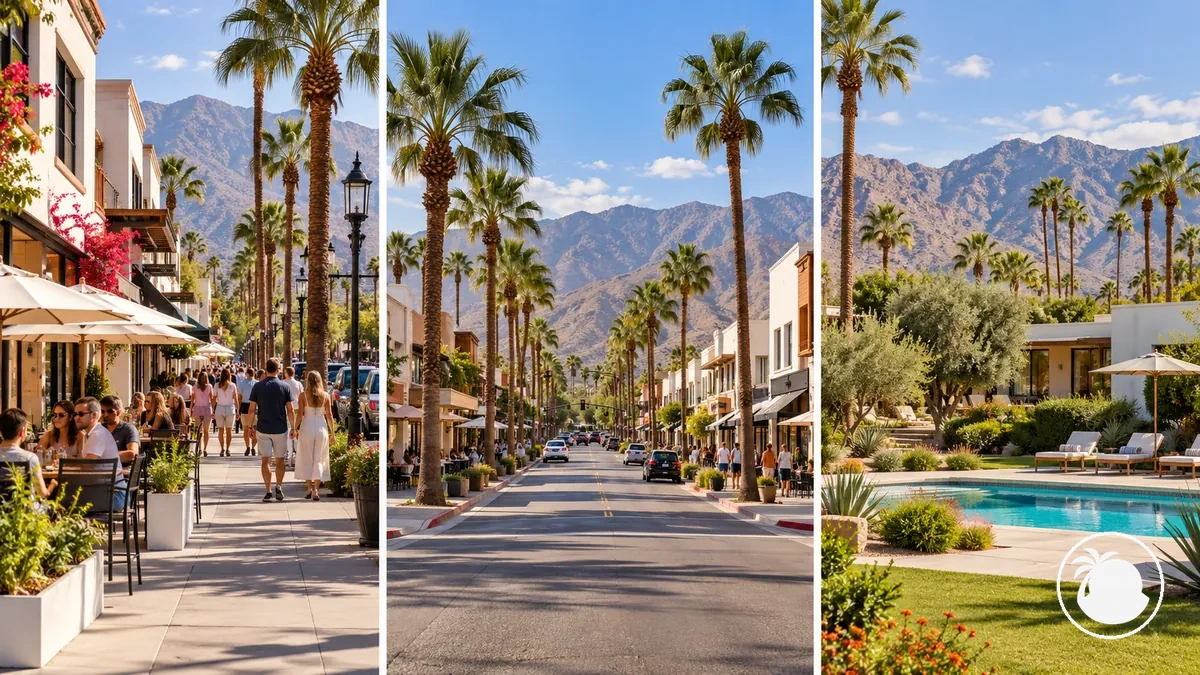
The comparison below aligns walkability, access to dining and shops, atmosphere, space, and transport dependence on one consistent basis.
These are qualitative area-level patterns, so suitability still depends on the exact accommodation location and traveller priority.
| Area type | Walkability and dining or shops | Atmosphere and space | Transport dependence | Short-stay trade-off |
|---|---|---|---|---|
| Downtown Palm Springs | Greater emphasis on walkable access to concentrations of dining and shops | More central activity and less emphasis on separation from commercial clusters | Can reduce reliance on additional transport for nearby everyday destinations | Suits travellers who prioritise central access and everyday convenience over a calmer, more separated setting |
| Uptown Palm Springs | Walkable access to local dining, shops, and activity can remain important, depending on the exact accommodation location | Combines a central connection with a setting that differs from the concentrated Downtown environment | Transport needs depend on the property location and destinations beyond the nearby area | Suits travellers seeking walkable local activity while accepting that access patterns can differ from Downtown |
| Quieter residential or resort-style areas | Dining and shops may be less concentrated within immediate walking reach | May offer a calmer atmosphere, more space, greater separation, or a resort setting with on-site amenities | Greater separation from commercial clusters may increase reliance on a car or other transport | Suits travellers who prioritise calm, space, separation, or on-site amenities over maximum central access |
For a short stay, the main trade-off is how much central access a traveller wants relative to calm, space, and separation.
Downtown may suit a trip centred on walkability and nearby dining and shops, while Uptown may suit travellers seeking walkable local activity with a different central setting.
Quieter areas or resort-style areas may suit travellers who place more value on atmosphere or space and are comfortable with potentially greater transport dependence.
The exact accommodation location remains important because these characteristics are not uniform across every property within an area type.
Downtown Palm Springs for Walkability and Short-Stay Convenience
Downtown Palm Springs may suit a short stay when the traveller prioritises walkability and concentrated access to restaurants, shops, galleries, and other common visitor stops.
The practical advantage depends on the exact property location, because accommodation within the downtown area does not automatically provide the same access to central corridors and nearby amenities.

Central corridors can place several everyday destinations within the same local area, reducing the need to arrange local transport for each routine stop when those destinations are accessible from the accommodation.
The main short-stay convenience comes from that concentration rather than from the Downtown Palm Springs label alone, with the practical advantages organised around three attributes:
- Nearby amenities: Proximity to restaurants, shops, galleries, and common visitor stops can allow more everyday needs to be handled on foot when they are accessible from the exact accommodation location.
- Central-corridor concentration: Accommodation near central corridors, including the Palm Canyon Drive context, can place multiple visitor-oriented destinations within a more concentrated walking environment rather than dispersing them across separate areas.
- Reduced routine transport: When useful destinations are concentrated within walking reach, a traveller may need less local transport for routine meals, shopping, and similar short-stay needs, while trips beyond the immediate area can still require other transport.
Uptown Palm Springs as a Walkable Alternative to Downtown
Uptown Palm Springs, particularly around the Uptown Design District, can provide a walkable accommodation alternative to Downtown Palm Springs when a short stay prioritises access to restaurants, shops, and local activity while allowing for a different immediate setting.
Both areas can support central access, but walkability and convenience depend on the exact accommodation location rather than the Uptown or Downtown label alone.

Uptown at a glance
- Local activity
- The Uptown Design District concentrates restaurants, shops, and local activity along a central area that can support everyday walking from suitably located accommodation.
- Downtown connection
- Where the street network and exact property location provide practical walking continuity toward Downtown Palm Springs, a traveller can combine Uptown access with the downtown core without treating the two settings as identical.
- Quietness
- Accommodation farther from the busiest central blocks may provide greater separation from concentrated activity, but this is property-specific; Uptown is not uniformly quieter.
- Best fit
- For a short stay, Uptown may suit travellers who want central walkability while preferring an immediate setting that differs from Downtown.
Quieter Residential and Resort-Style Areas for More Space and Separation
Quieter residential areas and resort-style settings are different Palm Springs accommodation environments, but both may suit a short stay that prioritises calm, space, or separation from the busiest central corridors.
Quieter residential pockets are defined here by their residential setting and potentially lower surrounding activity, while resort-style settings concentrate space and on-site amenities within the property environment rather than representing one fixed neighbourhood type.
Greater separation from central restaurant and shop clusters can change how these settings function during a short stay.
The attributes below show how surrounding activity, physical space, on-site amenity concentration, and location relative to restaurants and shops can affect convenience and transport reliance without implying that every property shares the same conditions.
- Surrounding activity: A quieter residential setting with lower surrounding activity, including during evenings, may provide more calm than a property beside a busy central corridor, but actual noise conditions depend on the specific accommodation and its immediate surroundings.
- Space and separation: Residential pockets or resort-style properties with more physical space around the accommodation can provide greater separation from concentrated central activity, while that separation may also place fewer everyday destinations within immediate walking reach.
- On-site amenities: Resort-style settings may concentrate pools and other on-site amenities within the property environment, allowing more of the stay to occur on site without implying that the accommodation is secluded or uniformly quiet.
- Transport reliance: When an accommodation location is farther from concentrations of restaurants and shops, routine trips to those destinations may require greater reliance on a car or other transport; the practical effect depends on the exact property location and the traveller's planned activities.
How Transport Constraints Change Where You Stay
Transport availability changes which accommodation area is practical for a short stay because it changes how much centrality is useful for daily movement.
Having a car can make a less central location workable, while limited or no car access can make walkability more important, but transport does not determine accommodation suitability by itself.
The relevant conditions are whether the traveller has a car, wants to walk to meals and shops, is willing to rely on rides or transit, and needs convenient arrival and departure.
These conditions connect transport constraints to accommodation-location consequences rather than defining how to use each transport mode.
- Car available: Access to a car can reduce reliance on a central location when the itinerary includes destinations beyond the immediate accommodation area, although parking and the exact property location can still affect convenience.
- Limited or no car access: When routine meals, shops, and other daily needs are expected to be reached on foot, greater walkability and centrality become more useful because they can reduce the need for additional transport.
- Comfortable using rides or transit: A traveller willing to use rides or transit may accept more separation from central destinations, while a low tolerance for additional transfers makes proximity to frequently used destinations more important.
- Arrival and departure needs: The usefulness of a central or less central accommodation area may also change with arrival and departure plans, particularly when those plans add transport connections before or after the stay.
The practical effect of each transport condition depends on the itinerary, exact property location, and the amount of daily movement expected during the stay.
A location that works well with a car or regular rides may be less practical for a traveller who expects to walk for most routine needs, while a highly central location may offer less additional value when frequent driving is already part of the itinerary.
Where to Stay When You Will Not Have a Car
Travellers staying in Palm Springs without a car should prioritise an accommodation location with practical walking access to the places they expect to use most during a short stay.
Downtown Palm Springs and parts of Uptown Palm Springs can be relevant central options when the exact property location provides useful walkability to meals and shops, but a named area alone does not make every property equally practical.
- Access to meals and shops: An accommodation location with useful everyday destinations within practical walking reach reduces reliance on additional transport for routine meals, shopping, and similar needs.
- Central activity corridor: A property positioned near the central activity corridor may provide more direct access to frequently used destinations, while the practical benefit depends on the exact property location rather than a Downtown Palm Springs or Uptown Palm Springs label.
- Expected rides or transit: If important itinerary stops fall outside practical walking reach, a car-free stay may still require rides or transit, so the expected frequency of those trips affects how useful a central accommodation location becomes.
- Staying farther from the core: Greater distance from concentrations of meals, shops, and planned activities can increase transport need when those destinations are not practically walkable from the property.
Airport Proximity Versus Downtown Convenience
Staying near Palm Springs International Airport may simplify arrival or departure, while staying in Downtown Palm Springs may reduce more day-to-day friction when a short stay centres on restaurants, shops, and central activity.
Airport proximity therefore trades transfer convenience at the beginning or end of the stay against the potential daily walking convenience of a downtown stay.
The comparison uses the same criteria for both accommodation locations: transfer simplicity, daily walking convenience, dependence on additional local transport, and the timing of arrival or departure.
| Location option | Arrival and departure | Daily walking convenience | Local transport need | Suitable short-stay condition |
|---|---|---|---|---|
| Near Palm Springs International Airport | Airport proximity may simplify the transfer between the accommodation and airport, making arrival or departure convenience more relevant to the location choice. | Walking access to restaurants and shops depends on the exact accommodation location rather than airport proximity itself. | May increase reliance on local transport when planned daily activities are concentrated away from the accommodation. | May suit a short stay when simplifying a late arrival or early departure carries more weight than maximising central daily access. |
| Downtown Palm Springs | Does not prioritise airport proximity, so arrival or departure may involve an additional transfer between the airport and accommodation. | May provide greater daily walking convenience when the exact property offers practical access to restaurants, shops, and central activity. | Can reduce reliance on local transport for daily activities that are accessible on foot from the property, while other itinerary stops may still require transport. | May suit a short stay when convenient access to central daily activities carries more weight across the stay than airport proximity. |
The more suitable location depends on where friction is concentrated in the itinerary.
An airport-adjacent stay may be more useful when a late arrival or early departure makes transfer simplicity especially important, while Downtown Palm Springs may reduce more recurring daily movement when planned activities are concentrated around its walkable central area.
Neither option is universally more convenient because the result depends on arrival and departure timing, the exact property location, and the rest of the short-stay itinerary.