
Planning a Joshua Tree Day Trip From Palm Springs
A Joshua Tree day trip from Palm Springs is practical when you can budget the approach drive and in-park driving separately, still leave meaningful time for your chosen stops, and protect a return buffer. Plan around available time, route and entrance fit, transport readiness, and current weather and park access; a half-day calls for fewer, route-aligned stops, while a fuller day gives more room for walking, delays, and optional stops.

Build the day in four decisions
Use these in order so the activity plan follows the real travel and operating conditions rather than an idealised stop list.
- Protect the time budgetSeparate the approach drive, in-park movement, activity time, breaks, and the return buffer. If travel expands, reduce stops or walking scope first.
- Choose the route for the stopsMatch the entrance and exit pattern to the locations you actually want to visit. A route that reduces backtracking preserves more usable park time.
- Confirm readiness before departureVerify fuel or charge, water, food, navigation, current park alerts, and any return transport arrangement before relying on the plan.
- Adjust to the day’s conditionsHeat, daylight, congestion, road access, mobility, and delays can narrow the workable activity window. Contract the plan or defer it when the remaining margin is no longer comfortable.
Core planning rule: keep optional stops conditional and protect the return buffer before trying to preserve the original stop count.
The excursion combines travel to Joshua Tree National Park with continued driving inside the park, so route choice and activity scope belong to the same time budget. Seasonal conditions, daylight, access, and your priorities determine how much of that budget can be used for viewpoints, scenic stops, and walks.
Table of Contents
When a Joshua Tree Day Trip From Palm Springs Is Worth the Time
A Joshua Tree day trip is worth the time when your available days leave room for a driving-heavy excursion and you value Joshua Tree National Park's desert scenery, scenic stops, or short hikes enough to allocate that time away from Palm Springs.
It becomes less suitable when driving time would consume too much of a constrained stay or leave too little park time for your priorities.
The main decision is the trade-off between time spent reaching and moving through the park and the experience you want once there.
The scenery and accessible sightseeing available at viewpoints and short-walk settings are the potential payoff being weighed against that travel commitment.

- Available days: A flexible stay makes allocating a full excursion easier; a short stay raises the opportunity cost because the day competes directly with other Palm Springs priorities.
- Park time after travel: The day is a better fit when the chosen schedule leaves enough park time for the scenery, viewpoints, or short hikes you actually want rather than making the visit primarily about driving and returning.
- Driving tolerance: Travellers comfortable with a driving-heavy day may find the excursion practical, while those who prefer a slower pace with less time in the car may find the same trade-off less suitable.
- Activity priorities: Strong interest in desert scenery, scenic stops, and short hikes gives the excursion a clearer purpose; if those experiences rank below Palm Springs activities, allocating the day becomes harder to justify.
- Seasonal constraints: Daylight, heat, and current conditions can narrow the practical activity window, so conditions that restrict outdoor time reduce the amount of useful park time available for the same travel commitment.
On a constrained short stay, giving a day to Joshua Tree can displace higher Palm Springs priorities; with more available days, that opportunity cost becomes easier to absorb.
Suitability therefore depends on whether the expected park time and activities justify the driving time within the pace and priorities of your Palm Springs stay.
How Much Time to Allow for a Joshua Tree Day Trip
The total duration of a Joshua Tree day trip from Palm Springs needs to include the outbound driving time, in-park driving, stops, walking time, breaks, and the return drive rather than one fixed block of park time.
No single total duration applies across different routes, traffic conditions, activity scopes, and seasonal conditions, so plan travel time separately from the usable park time that remains.
Adding viewpoints, walks, or longer stops increases the required park time or reduces the time available for other activities within the same day length.
In-park driving also belongs in the time budget because movement between chosen locations continues after arrival.
Breaks expand or contract with personal pace and conditions, while congestion and parking can further reduce usable park time; the National Park Service advises that busy periods can involve long entrance lines, limited parking, and busy trails.
The day is therefore easier to plan as separate travel, activity, and return portions rather than as one continuous park visit.
Use the illustration as a sequence model rather than a fixed timetable: the actual duration comes from your route, stops, walking pace, breaks, congestion, and the return margin you choose to protect.
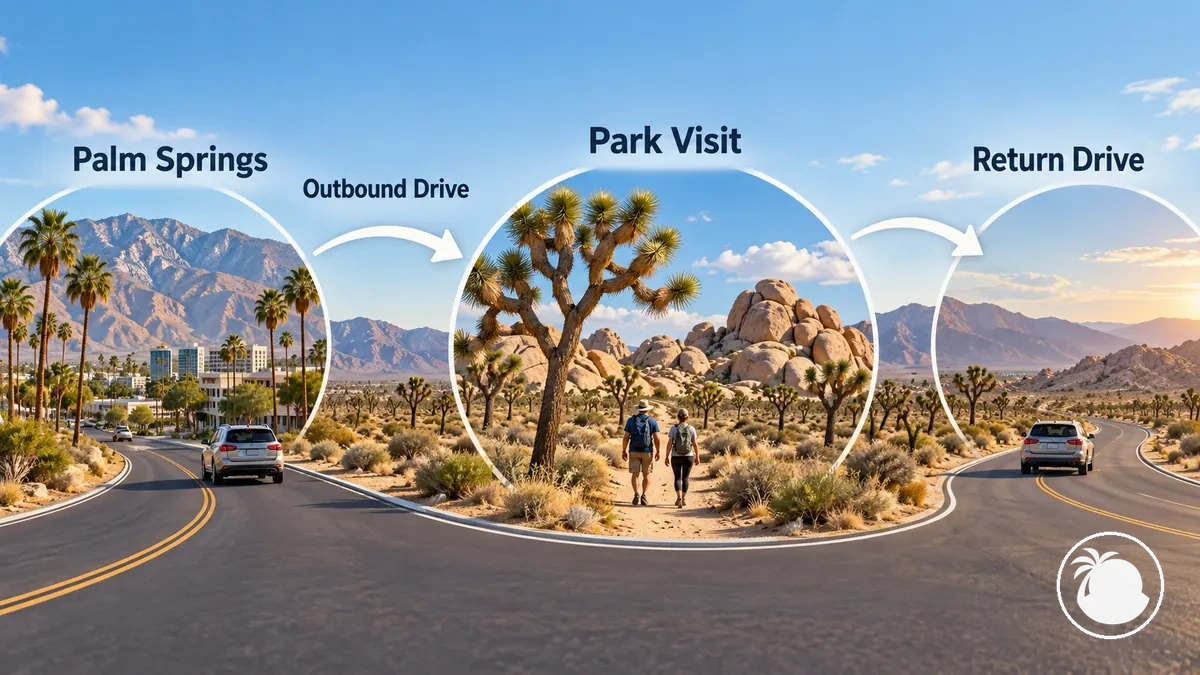
| Time component | What changes it | Planning implication |
|---|---|---|
| Outbound drive | Starting point, route, traffic, and entrance congestion | More travel or queuing leaves less usable park time unless the total day length expands |
| In-park movement | Distance between chosen stops, road conditions, congestion, and parking | More movement between locations reduces time available for viewpoints and walks |
| Stops and walking time | Number of scenic stops, chosen walks, and time spent at each location | A broader activity scope requires more park time or fewer other stops |
| Breaks | Weather, rest needs, meals, and personal pace | Longer or more frequent breaks reduce activity time within the same day length |
| Return buffer | Traffic, conditions, daylight, and the required return time | A larger return buffer leaves less late-day park time but more flexibility for delays |
A compressed visit can prioritise fewer stops or shorter walks to preserve the return buffer, while a fuller day can allocate more park time to scenic stops and walking without relying on a fixed schedule.
The total time budget changes most with driving conditions, activity scope, walking pace, breaks, congestion, and the return buffer you choose to retain.
Driving Time From Palm Springs to Joshua Tree
Driving time from Palm Springs to Joshua Tree is best planned as two separate driving blocks: the approach from your actual starting point to a specific park entrance, and the additional driving needed to move between stops and toward the planned exit inside Joshua Tree National Park.
The diagram below visualises the same distinction. When either driving block grows, usable park time falls unless the overall day expands; reduce the number of stops, walking scope, or detours rather than assuming the travel portion is fixed.

Half-Day Versus Full-Day Feasibility
A half-day and full-day Joshua Tree visit from Palm Springs differ mainly in the usable park time left after the approach drive and in-park movement are accounted for.
A half-day creates a tighter activity scope and return buffer, while a full-day allows more park time for stops and walking without requiring one fixed itinerary.
The comparison below uses the same criteria for both options: usable park time, likely stop scope, walking scope, pace, and the return-buffer implication.
The graphic compares the relative activity scope of the two options rather than promising fixed durations; actual timing still depends on travel, route, pace, conditions, and the return buffer.

| Option | Usable park time | Likely stop scope | Walking scope | Return-buffer implication |
|---|---|---|---|---|
| Half-day | More limited after travel and in-park driving | Fewer selected stops | Narrower walking scope or shorter walks | A tighter pace or broader activity scope can reduce the return buffer |
| Full-day | More available after travel and in-park driving | More flexibility for additional stops | Wider walking scope or more time at selected walks | More flexibility to retain a return buffer while allocating time to park activities |
A half-day suits a schedule that accepts fewer stops, a narrower walking scope, and a tighter pace, while a full-day suits a schedule that allocates more time to the excursion and allows a broader scope without making that option universally preferable.
A longer Palm Springs stay can make a full excursion easier to accommodate within the overall trip.
The trade-off is between breadth of park activity and the time pressure created by travel, pace, conditions, fatigue, and the return buffer.
Choosing a Driving Route and Joshua Tree Entrance From Palm Springs
The most practical Joshua Tree entrance from Palm Springs is the one that fits your intended park route, not automatically the geographically closest entrance.
Entrance choice affects the approach, where the park day begins, and how much backtracking may be required between intended stops and the eventual exit direction.
The diagram illustrates this route-choice logic rather than live navigation, showing that Palm Springs can connect to different park entry points and route patterns.
Use the following criteria to distinguish a close entrance from an entrance that better fits the planned sequence.
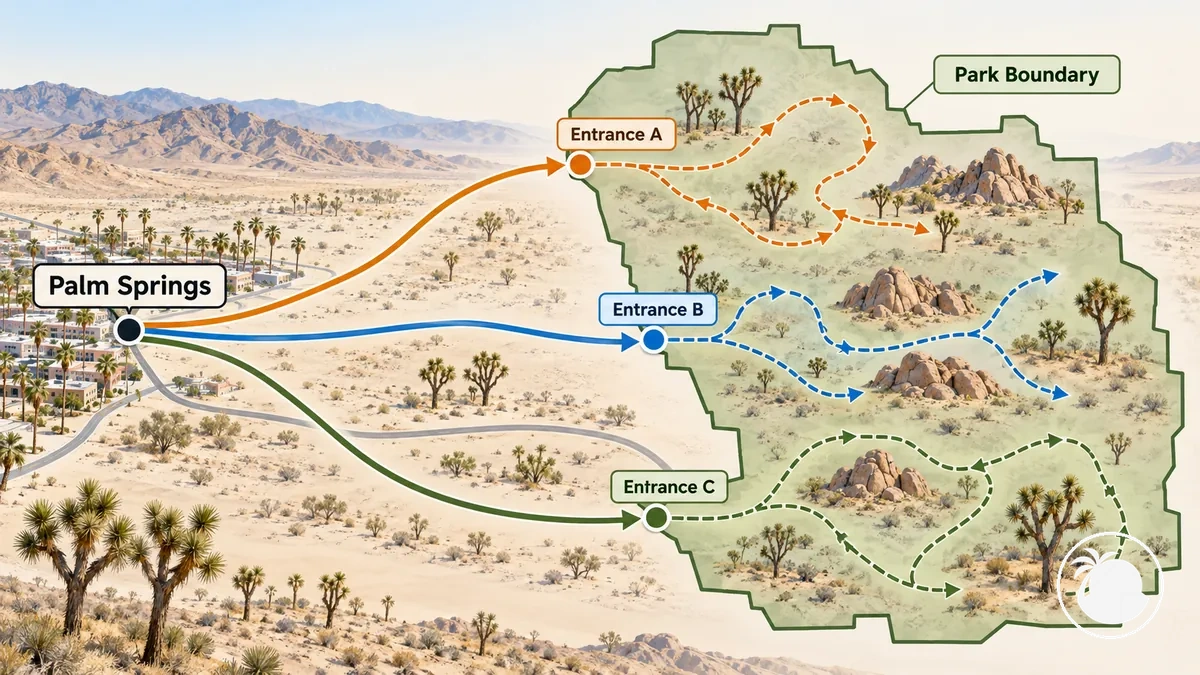
- Starting point: Use your actual Palm Springs starting point to evaluate the highway approach rather than assuming every traveller begins from the same location.
- Intended stops: Choose an entrance that aligns with the locations you intend to visit, because an entry point that starts the day away from those stops can add in-park driving.
- Exit direction: Consider where you expect to leave Joshua Tree National Park; an entrance that supports a logical entry-to-exit sequence may reduce backtracking compared with returning to the same entry point.
- Backtracking: Compare how each candidate entrance affects repeated driving between intended stops. A geographically closer entrance may be less efficient when it conflicts with the planned sequence.
- Current access: Verify road conditions, closures, and entrance access before relying on a route. The National Park Service identifies West, North, and South entrance stations and advises visitors not to rely solely on vehicle navigation systems because they can direct drivers onto backcountry roads that may be impassable to their vehicle.
Starting point, intended stops, exit direction, and backtracking therefore need to be evaluated together rather than treating proximity as the deciding factor.
Current road conditions and access can change route practicality, so verify National Park Service current-condition and closure information before departure.
Route efficiency is ultimately a route-fit decision: the suitable entrance is the accessible one that aligns with the planned park sequence under current conditions, rather than one entrance being prescribed for every Palm Springs day trip.
Which Entrance Fits the Planned Park Route
Entrance fit depends on where your intended stops sit in the planned route and whether you expect to retrace the same route or continue through Joshua Tree National Park toward a different exit.
The National Park Service identifies three entrance stations—West, North, and South—so the appropriate entry point depends on how an available entrance aligns with the day's stop sequence.
The annotated example illustrates route fit and backtracking rather than exact navigation, showing how two entrance choices can produce different path patterns through the park.

- Planned stop sequence: An entrance fits when its approach direction aligns with the intended stops near the beginning of the route, reducing unnecessary movement before the planned sequence starts.
- Enter and retrace: If the plan is to return through the same entrance, account for the in-park route that must be driven again after the final stop; adding stops farther from that entry point can increase backtracking.
- Continue toward a different exit: If current road access supports a through-route, an entrance that aligns the intended stops toward another exit can improve route continuity and reduce repeated driving.
- Current access: Confirm that the intended entrance, roads, and exit are accessible before relying on either route pattern, because current conditions determine whether the planned sequence is practical.
Approach direction establishes where the park sequence begins, while the intended exit determines whether later driving continues forward or retraces earlier road segments.
Greater backtracking increases repeated in-park driving, while a route that aligns the entrance, intended stops, and exit can reduce it.
Entrance choice should therefore serve the planned route and route continuity under current access conditions.
Planning the Drive Through the Park and Back to Palm Springs
The in-park drive plan should preserve time for planned stops while maintaining a return buffer for the drive back to Palm Springs.
Set the entry timing and route direction around that return margin rather than assuming the full planned sequence will remain practical if delays develop.
The sequence should coordinate readiness, entry, movement through stop clusters, time monitoring, a turnaround point, and the final exit or return decision.
Because road conditions and delays can change the usable time, treat the plan as adjustable rather than as an uninterrupted schedule.
- Confirm readiness before entry. Check current National Park Service road and access information, confirm the intended route direction, and make sure the vehicle has sufficient fuel or charge for the planned drive; do not assume fuel or charging will be available at a particular point without current verification.
- Enter on the selected route. Use the planned entry timing and follow the chosen route direction so the drive begins with the intended stop sequence rather than adding unnecessary backtracking.
- Move through stop clusters. Group nearby planned stops where practical and continue along the in-park route instead of treating every possible attraction as part of the drive-through plan. Keep navigation available, but verify the route against current park information rather than relying on vehicle navigation alone.
- Monitor elapsed time and the return buffer. Compare progress with the remaining stops and the time still needed to exit the park and return to Palm Springs. Delays from traffic, parking, longer stops, or changing conditions should reduce the remaining activity scope rather than consume the return margin.
- Use a clear turnaround point. Before continuing to another stop cluster, verify that enough return buffer remains for the intended exit and return leg; if delays have eroded that margin, shorten the plan and begin the return sequence instead of adding more stops.
- Commit to the exit and return. Before the final return decision, confirm that the remaining return buffer still covers the planned exit and drive back to Palm Springs under current conditions. Once confirmed, follow the planned exit or turnaround route rather than reopening the activity sequence.
What to Prepare Before Leaving Palm Springs
Before leaving Palm Springs for Joshua Tree National Park, confirm the vehicle has sufficient fuel or charge, carry water and food for the day, prepare reliable navigation, and check the weather, park alerts, and access requirements.
Footwear and heat protection should also match the activities and conditions you expect during the visit.
The National Park Service advises visitors to plan ahead because there are no gas stations, restaurants, grocery stores, or hotels inside Joshua Tree National Park, water is not available in the park interior, and cell service is limited.
Current conditions can also affect roads and access, so complete the time-sensitive checks before departure and carry the supplies needed for the planned day.
Before you leave: essential checks
- Verify park alerts and access requirements: Check current National Park Service information for road conditions, closures, entrance access, and any time-sensitive requirements that could affect the planned route.
- Confirm fuel or charge: Make sure the vehicle has sufficient fuel or charge for the planned drive and in-park movement rather than relying on service availability inside the park.
- Prepare navigation: Confirm the route before departure and keep reliable or offline navigation available because cell service can be limited. The National Park Service also advises against relying solely on vehicle navigation systems, which can direct drivers onto unsuitable backcountry roads.
- Carry water: Bring the drinking water needed for the day rather than planning to obtain water in the park interior.
- Carry food: Bring enough food for the planned excursion because restaurants and grocery stores are not available inside the park.
- Check weather and heat protection: Review the current forecast and prepare appropriate sun and heat protection for the expected conditions without assuming the same precautions apply in every season.
- Confirm footwear and activity needs: Choose footwear and other basic activity preparation that suit the walks, surfaces, and stops actually included in the day plan.
- Recheck current information before departure: Confirm that the latest park alerts, road conditions, closures, and access requirements still support the planned day trip before leaving Palm Springs.
A Practical One-Day Sequence Through Joshua Tree
An efficient one-day Joshua Tree sequence begins at the selected entrance and prioritizes route continuity, a limited number of geographically coherent stops, and enough time for the return to Palm Springs.
Treat each stage as part of a flexible day sequence rather than trying to fit every viewpoint or short activity into one visit.
The timing of each stage should adjust to daylight, crowding, road conditions, activity preference, and the time already used.
Prioritize coherent stops before optional additions, use breaks and elapsed-time checks to protect the return buffer, and keep a clear turnaround or exit decision available if the day is taking longer than planned.
Route sequence
- Begin with arrival and orientation. Enter through the selected entrance, confirm the route direction, and start with the first planned stop cluster that supports route continuity rather than adding immediate backtracking.
- Continue through the first stop cluster. Use the planned stop order for a bounded number of scenic stops, viewpoints, or other short activities along the route. Keep each activity duration flexible so one longer stop does not automatically force the rest of the sequence.
- Add a short walk or viewpoint. Choose a short activity that fits the route and current conditions rather than detouring solely to increase the number of stops. Continue along the planned direction after the activity to preserve route continuity.
- Take a break and reassess elapsed time. Compare the remaining daylight, current conditions, planned exit, and return buffer with the stops still under consideration. If delays or longer activities have reduced that buffer, shorten the remaining sequence before adding an optional later stop.
- Add a later stop only if the buffer supports it. Continue to an optional viewpoint, short hike, or scenic stop when it fits the route and still leaves adequate time for the planned exit and return to Palm Springs. Otherwise, omit the optional addition rather than extending the day beyond the protected return margin.
- Use the turnaround or exit decision. At the planned decision point, confirm that the remaining route and current conditions still support the intended exit. If they do not, shorten the route and begin the exit sequence instead of adding further stops.
- Exit and return to Palm Springs. Once the return decision is made, follow the planned exit or turnaround route and preserve the remaining return buffer for the drive back to Palm Springs.
Prioritising Scenic Stops, Short Hikes, and Viewpoints
Choose a small set of scenic stops, short hikes, and viewpoints that provide distinct experiences while maintaining route fit and limiting detours and time cost.
Prioritising fewer, geographically coherent stops leaves more remaining time for the activities you choose and for the return buffer.
Evaluate each candidate by the same criteria: how well it fits the route, how much time it adds, the physical effort required, and whether it adds a different experience from stops already selected.
A short hike can require more walking time and physical effort than a roadside scenic stop or viewpoint, with heat and current conditions potentially increasing that effort.
Stops that require substantial detours also carry a higher time cost because they add driving before the day can continue along the planned route.
- Scenic stop with strong route fit: Prioritise a scenic stop already on or close to the planned route when it adds a distinct landscape experience without requiring substantial additional driving. Its lower detour cost leaves more remaining time for later activities.
- Viewpoint stop: A viewpoint fits well when it provides a distinct visual experience along the existing route and does not require a significant detour. Account for the time spent parking, viewing, and rejoining the route rather than treating the stop as time-free.
- Short hike: Include a short hike when its walking time and physical effort fit the day's conditions and available time. Heat, walking pace, and the chosen route can increase its practical time cost, so a longer activity may require removing another stop.
- Stop requiring a detour: Treat a stop away from the planned route as a higher-cost addition because reaching it adds driving as well as the activity itself. Keep it when the experience adds enough variety to justify the detour without undermining the remaining route.
- Optional later stop: Add another scenic stop, short hike, or viewpoint only when the remaining time and return buffer still support it. If earlier activities, crowding, or conditions have consumed more time than planned, omit the optional stop rather than compressing the return.
A balanced selection can combine a route-aligned scenic stop or viewpoint with one short hike and leave later stops conditional on remaining time, conditions, and the return buffer.
Adding one more stop generally means allocating less time to another activity, reducing the return buffer, or extending the overall day.
Avoiding an Overpacked Day-Trip Itinerary
An overpacked itinerary tries to fit more stops and activities into the day than the real time remaining after travel and in-park driving can support.
Too many stops, long walks, and repeated detours consume that available time and create time pressure as the planned return to Palm Springs approaches.
Signs of an overloaded plan include delays accumulating between stops, walking activities taking longer than the schedule can absorb, or the return buffer shrinking before optional activities have been reached.
A workable plan keeps the stop count and walking scope flexible enough that a delay can be absorbed through a clear correction rather than by consuming the return buffer.
- Too many stops: Adding stops increases elapsed time through extra parking, activity time, and possible detours; recognise overpacking when later stops depend on earlier ones finishing without delay. The correction is to remove a lower-priority stop and preserve the remaining time for the core plan.
- Underestimated in-park driving: Treating movement between stops as negligible reduces the time available for activities and the return buffer; recognise this when the planned stop order leaves little room for driving between locations. The correction is to reduce the stop set or remove a detour rather than compressing every activity.
- Stacked long walks: Combining several long walks can increase walking time and physical effort, with heat and other conditions potentially increasing the practical demand. If completing one walk puts later activities under time pressure, the correction is to shorten the walking scope or replace a later walk with a shorter activity.
- Insufficient return buffer: A plan that allocates nearly all remaining time to park activities leaves little flexibility for traffic, parking delays, or a slower-than-expected day. If a modest delay would force the planned return later, the correction is to remove an optional activity and restore the return buffer.
- Ignored seasonal limits: Daylight, heat, and current conditions can change how much activity is practical within the planned day. If conditions reduce the usable activity window or make a planned walk unsuitable, the correction is to shorten the activity scope and move the turnaround or exit decision earlier.
An overpacked plan tries to preserve the original stop count, walking scope, and activities as the return buffer shrinks; a workable plan reduces one of those demands when time is lost.
Removing one low-priority activity can restore remaining time and protect the return buffer without requiring the entire day-trip plan to be abandoned.
Situations That Change Day-Trip Feasibility
The same Joshua Tree day-trip plan can become more or less feasible when weather, daylight, transport access, mobility, or schedule flexibility changes the time and activity scope available.
A condition that creates only a manageable constraint on one day can require a larger adaptation when it combines with limited time or another restriction.
Weather can change exposure and the practical scope of outdoor activities, while daylight affects timing and the return buffer.
Transport access changes which routes and stops are practical, mobility affects the effort and time required for planned activities, and schedule flexibility determines how easily the plan can absorb a delay.
These conditions should therefore be evaluated by the planning consequence they create rather than treated as automatic reasons to proceed with or abandon the trip.
- Weather: Heat or other adverse weather can constrain outdoor activity and reduce the practical safety margin for the original plan. The adaptation may be to shorten exposed activities, reduce the activity scope, or defer the trip when conditions cannot be accommodated within a workable plan.
- Daylight: Limited daylight reduces the time available for stops while preserving a suitable return buffer. Adapt by reducing the planned activity scope or moving the turnaround and exit earlier rather than assuming the original schedule still fits.
- Transport access: Limited vehicle or route access can constrain which entrances, stops, and route patterns are practical. Adaptation requires choosing a transport and route plan that can reliably support the intended stops; if suitable access cannot be established, the original day-trip plan may be impractical.
- Mobility: Reduced mobility can increase the time or effort required for walking-based activities and change which stops fit the day. Adapt by selecting activities compatible with the traveller's mobility and allowing enough time for movement without compressing the return buffer.
- Schedule flexibility: A flexible schedule can absorb some delay by shortening or removing optional activities, while a fixed return requirement leaves less room for disruption. When limited schedule flexibility combines with weather, access, or mobility constraints, reducing the activity scope may no longer provide enough margin to keep the original plan feasible.
Conditions that affect only one part of the plan can often be handled through adaptation, such as reducing activities or changing timing, while combined constraints can make the intended day trip impractical.
The feasibility decision should reflect the conditions operating together, with the strongest weather and transport-access cases considered separately where they materially change the plan.
How Summer Heat Changes the Day-Trip Schedule
Summer heat can require earlier departure timing, shorter periods of outdoor exposure, and a reduced walking scope during a Joshua Tree day trip.
As heat conditions become more demanding, short hikes and exposed stops may need to be shortened, moved to cooler periods, or removed so the schedule retains time for breaks and the return journey.
Heat can increase the physical demand of outdoor activity, so stop duration, exertion, water planning, access to shade, and vehicle readiness become more important parts of the day plan.
The National Park Service advises visitors to avoid strenuous activity during the hottest part of the day, carry adequate water, and check current conditions; specific activity limits should therefore follow current weather and official park guidance rather than a fixed temperature cut-off.
- Departure timing: When hotter conditions are expected later in the day, earlier timing can place more outdoor activity in relatively cooler periods. The schedule should still account for daylight, driving, and the required return buffer rather than simply adding more activities because the day starts earlier.
- Walking scope: Summer heat can increase exertion during exposed walking, making a plan built around several short hikes less practical under hotter conditions. Reduce the number, length, or exposure of planned walks when current conditions warrant a more conservative activity scope.
- Water, shade, and breaks: Hot weather can increase the need for water and recovery time, so carry water for the planned day and allow for breaks in available shade or other suitable recovery settings. Do not rely on obtaining water in the park interior, where the National Park Service advises that water is not available.
- Vehicle readiness: Confirm sufficient fuel or charge and the vehicle's readiness for the planned route before departure. Keep the vehicle plan compatible with the intended route and current park access information rather than relying on services inside the park.
- Current-condition verification: Check current weather and National Park Service park guidance before leaving Palm Springs and adjust the schedule to the conditions expected that day. More severe heat conditions warrant a more conservative combination of outdoor exposure, walking scope, stop duration, and timing rather than assuming every summer day supports the same plan.
When current conditions make the normal activity scope too demanding, contract the schedule by shortening outdoor segments and removing lower-priority walks or stops before reducing the return margin.
Use current weather and official National Park Service guidance to determine the specific limits for the day rather than relying on a universal summer threshold.
Visiting Joshua Tree From Palm Springs Without a Car
A car-free Joshua Tree day trip from Palm Springs is feasible only when the chosen transport solves both park access and practical in-park mobility.
Reaching a gateway or park entrance does not by itself provide transport between intended stops or a reliable return to Palm Springs.
Transport options should therefore be evaluated by whether they reach the park, support movement through the intended route, provide enough schedule control for planned stops, and offer acceptable return reliability.
Service availability, operating schedules, reservations, pickup coverage, and return arrangements can change, so these details require current verification before the day trip is planned around them.
| Transport option | Gets to the park | Supports in-park mobility | Schedule control | Return reliability |
|---|---|---|---|---|
| Prearranged organised service that includes park transport | Yes, when the booked service includes Palm Springs pickup and park access | Yes, when movement between the intended stops is included in the service | Limited to the booked itinerary, operating times, and included stops | Linked to the booked return arrangement; current service details and reservations must be verified |
| Point-to-point transport to a gateway or entrance | Potentially, when the provider serves the required destination | Not by itself; reaching the park boundary does not solve movement between intended stops | Limited when separate transport is needed for each stage of the park visit | Requires confirmed return availability rather than assuming the outbound transport can provide the return journey |
| Prearranged private transport retained for the excursion | Yes, when the service explicitly includes the required park access | Potentially, when the arrangement includes the planned in-park route and intended stops | Greater when pickup, stops, route, and return are agreed in advance | Requires a confirmed booking and return arrangement |
General Palm Springs transport decisions, including choosing local transportation, are separate from the additional problem of moving through Joshua Tree National Park once the excursion begins.
For a car-free day trip, verify current service availability, park access, in-park mobility, intended stops, reservations where required, and the return arrangement before relying on any transport mode.