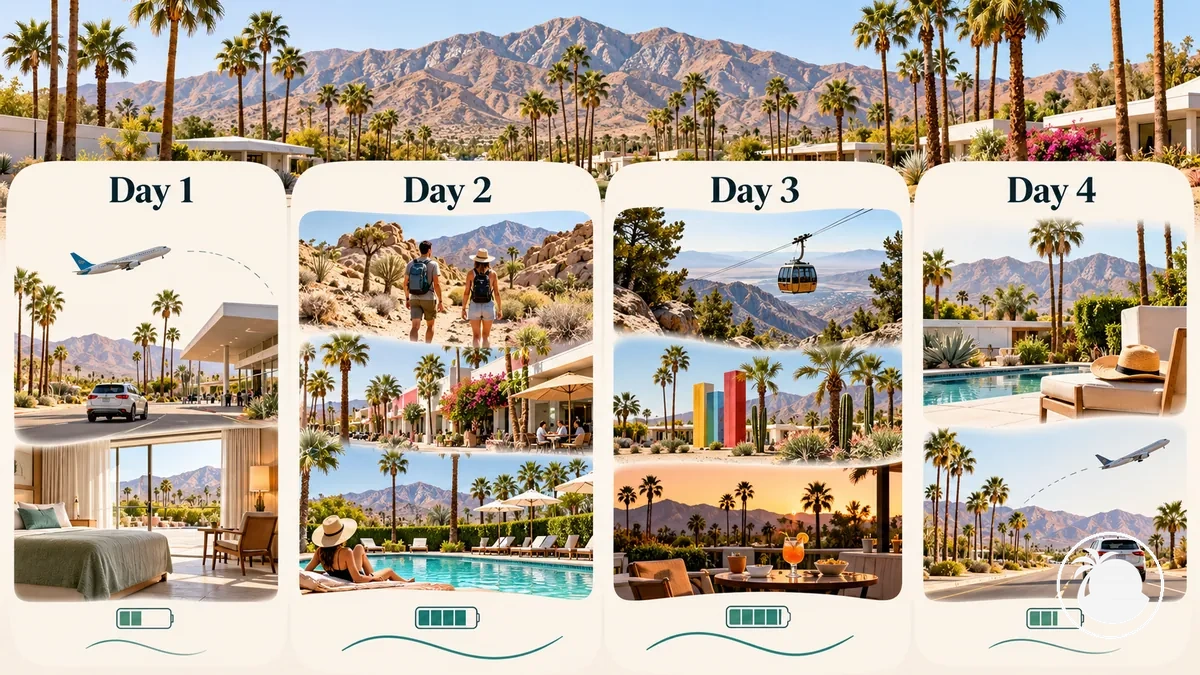
For a relaxed four-day Palm Springs trip, keep Day 1 light after arrival, use Day 2 for the main local sightseeing, choose Day 3 as either a local day or a Joshua Tree excursion, and keep Day 4 flexible around departure. Group nearby activities, protect downtime, and adjust timing or geographic reach when heat, transport access, daylight, or the arrival and departure windows reduce usable time.
Four-day planning framework
Use the itinerary as a sequence of workload and flexibility rather than a fixed clock-time schedule.
Day 1 · Light start
Arrive, check in, assess remaining daylight and energy, then add one nearby low-friction activity only if the usable window supports it.
Day 2 · Main local day
Give the first full day the largest local sightseeing block, group nearby activities, and keep space for meals, transitions, or recovery.
Day 3 · Choice day
Keep the day local for more flexibility, or choose a Joshua Tree excursion when full-day availability, daylight, transport, conditions, and travel effort make it practical.
Day 4 · Flexible finish
Protect packing, checkout, and the departure transfer first; use only the remaining window for a nearby, flexible activity.
What changes the plan
Short boundary day
Reduce Day 1 or Day 4 intensity.
Longer excursion
Accept more travel effort and less local flexibility on Day 3.
Summer heat
Shift exposed or higher-exertion outdoor activity toward cooler periods when conditions warrant it.
Car-free travel
Use a smaller daily radius and fewer transfers between activity clusters.
Treat the four days as an adaptable workload sequence: usable time, geographic spread, energy, season, transport access, and excursion choice determine how much each day can comfortably carry.
Table of Contents⌄
How to Divide Four Days in Palm Springs
A four-day itinerary works best as a workload sequence: keep the arrival and departure days lighter, while Day 2 and Day 3 can carry more sightseeing when usable time and trip conditions allow.
This pace leaves the fuller middle days for activities that benefit from longer uninterrupted periods without turning the schedule into an exact timetable.
Allocate each day by checking three constraint types: time constraints such as usable arrival and departure time, geographic constraints such as travel time and the spread between areas, and effort constraints such as energy and desired downtime.
An excursion may take a larger share of a middle day, so the remaining sightseeing should be scaled accordingly.
These criteria keep the four days focused on feasible day allocation rather than maximizing the number of stops.
The image visualizes relative day intensity across the four-day Palm Springs schedule, with lighter boundary days and fuller middle days rather than fixed hours or attraction counts.
Day 1: Assign a lighter arrival-day workload that uses only the time and energy available after reaching Palm Springs.
Day 2: Use a fuller sightseeing day for activities that fit together without unnecessary travel time or backtracking.
Day 3: Reserve another substantial activity period, adjusting its workload if the trip includes a longer excursion.
Day 4: Scale the final day around departure time, keeping the pace lighter when usable time is limited.
This allocation is a planning frame rather than a rigid timetable, so the daily workload can shift with usable time, geographic spread, energy, transport conditions, and excursion choice.
Day 1: Arrive, Settle In, and Explore at an Easy Pace
Arrival time determines how ambitious Day 1 in Palm Springs can be.
An earlier arrival may leave usable time for a nearby activity, while a late arrival may make settling in the appropriate endpoint for the day.
Usable time depends on the arrival window, accommodation access and check-in, remaining daylight, travel fatigue, and proximity to an easy activity.
If luggage or check-in delays settling in, shorten the activity block rather than increasing the pace.
When daylight or energy is limited, keep the first day focused on getting oriented and leave sightseeing for later.
The image represents a low-friction first-day rhythm in Palm Springs, showing arrival and settling in alongside a calm nearby setting rather than a required sightseeing stop.
Use this three-step sequence to scale Day 1 with the arrival window and the time and energy remaining:
Arrive and check in: Reach Palm Springs, handle luggage and accommodation access, and establish how much usable time remains.
Settle in and assess: Consider remaining daylight, travel fatigue, and proximity before deciding whether to continue.
Add one nearby activity: Choose one low-friction local activity at an easy pace only when sufficient time and energy remain.
An early arrival may allow the third step to become a short local activity block; a late arrival may leave no meaningful sightseeing window.
In that case, stop after settling in and allow Day 1 to remain flexible.
Day 2: Use a Full Day for Palm Springs Sightseeing
Day 2 should carry the main local Palm Springs sightseeing load because it is the first fully available day in the itinerary.
Use the full day as a small number of activity blocks rather than an exhaustive attraction list, leaving enough space between blocks to maintain a relaxed pace.
Sequence each activity block by geography and expected travel time so that a main activity can be combined with a nearby secondary stop without unnecessary backtracking.
A fixed-time activity may need to anchor the order, while a flexible activity can move around it according to availability and energy.
Leave rest space for a meal break or recovery time instead of treating every part of the day as sightseeing time.
Where venue access or timing matters, the relevant conditions should be verified rather than assumed.
The image illustrates the scale and atmosphere of a full local sightseeing block in Palm Springs rather than prescribing a particular attraction or stop.
Follow these activity blocks as a sequence, treating each block as a purpose within the day rather than a mandatory individual attraction:
Start with the primary sightseeing block: Reserve the largest usable period for the main activity, particularly when it is a fixed-time activity or has operating conditions that should be verified.
Combine a nearby secondary activity: Group a flexible activity or secondary stop close to the primary area so travel time does not consume an unnecessary share of the full day.
Leave flexible or recovery time: Keep space for a meal, rest, or another flexible activity, and shorten this block when earlier sightseeing or travel takes more time than expected.
Prioritize proximity and a workable pace over the number of attractions completed.
Day 3: Choose Between a Local Day and a Joshua Tree Excursion
Day 3 is a choice between keeping a local day in Palm Springs and using the day for a Joshua Tree excursion.
The local option fits when preserving downtime and flexibility matters more, while the excursion fits when full-day availability, sufficient daylight, suitable transport, acceptable weather, and willingness to take on greater travel effort support a longer day trip.
Current weather, access conditions, and transport arrangements should be verified when they affect excursion suitability.
The image contrasts the character of local relaxation with a longer desert excursion rather than showing the complete logistics of either option.
Compare Day 3 by the same four criteria
Local day
Travel effort
Keeps the travel commitment lower by remaining in Palm Springs.
Usable day
Preserves more local time and flexibility when full-day availability or daylight is limited.
Transport and weather
Requires only the transport needed for the chosen local activities, while conditions can shape what remains practical.
Effect on pace
Leaves more room for downtime and an unhurried Day 3.
Joshua Tree excursion
Travel effort
Adds a longer travel commitment and shifts more of Day 3 away from Palm Springs.
Usable day
Fits more naturally when full-day availability and sufficient daylight support the excursion.
Transport and weather
Requires suitable transport and conditions for the planned trip, which should be verified when relevant.
Effect on pace
Trades some local flexibility and downtime for a longer desert excursion.
For example, a traveller prioritizing downtime may keep Day 3 local, while someone with a full usable day, suitable transport, sufficient daylight, and acceptable conditions may choose the Joshua Tree excursion.
Detailed planning for the Joshua Tree excursion from Palm Springs remains outside this subsection because routes, stops, and attraction choices belong to the dedicated excursion guidance.
Day 4: Keep the Final Day Flexible Around Departure
Build Day 4 around the departure time, protecting packing, checkout, and transfer needs before adding sightseeing.
Use only the usable time that remains for a nearby activity or flexible activity that fits within the departure window.
Activity capacity depends on the departure time, the transfer buffer planned for the journey, the activity duration, and its distance from the departure point.
A shorter usable window should limit Day 4 to a lower-commitment activity, while a larger window can support more local time without turning the final day into a full excursion.
Packing and checkout also reduce the available window, so account for them before committing to an activity.
When little or no usable time remains, Day 4 may function primarily as a departure day and the trip effectively contains three substantive sightseeing days.
The image represents a calm, low-commitment final-day option in Palm Springs before departure rather than a packed sightseeing schedule.
The three conditions below organize Day 4 by departure window rather than fixed clock times, showing how usable time changes the appropriate activity intensity.
Early departure: Little or no usable sightseeing time may remain, so prioritize packing, checkout, and departure rather than adding another activity block.
Middle-of-day departure: If usable time remains after departure needs are protected, fit one nearby activity with a short, flexible commitment and convenient access back toward the departure point.
Later departure: A larger usable window can support a longer flexible activity or more local time, provided its duration and distance still leave the planned transfer buffer intact.
How to Keep the Four-Day Schedule Relaxed
A relaxed four-day schedule comes from protecting buffer time, limiting unnecessary travel time, and adjusting demanding activities when they put pressure on the plan rather than simply removing sightseeing.
Start with a workable baseline schedule, then identify which pressure variable is reducing flexibility and make the smallest useful adjustment.
Evaluate schedule density by checking whether activities, travel, meals, and fixed reservations leave enough breathing room for the intended pace.
Travel time and backtracking consume usable time, while energy demand and weather exposure can make an otherwise workable activity sequence harder to sustain.
Fixed reservations reduce timing flexibility, and insufficient recovery time can make later activity blocks less practical.
The appropriate adjustment therefore depends on which constraint is creating pressure rather than on a universal activity limit or buffer duration.
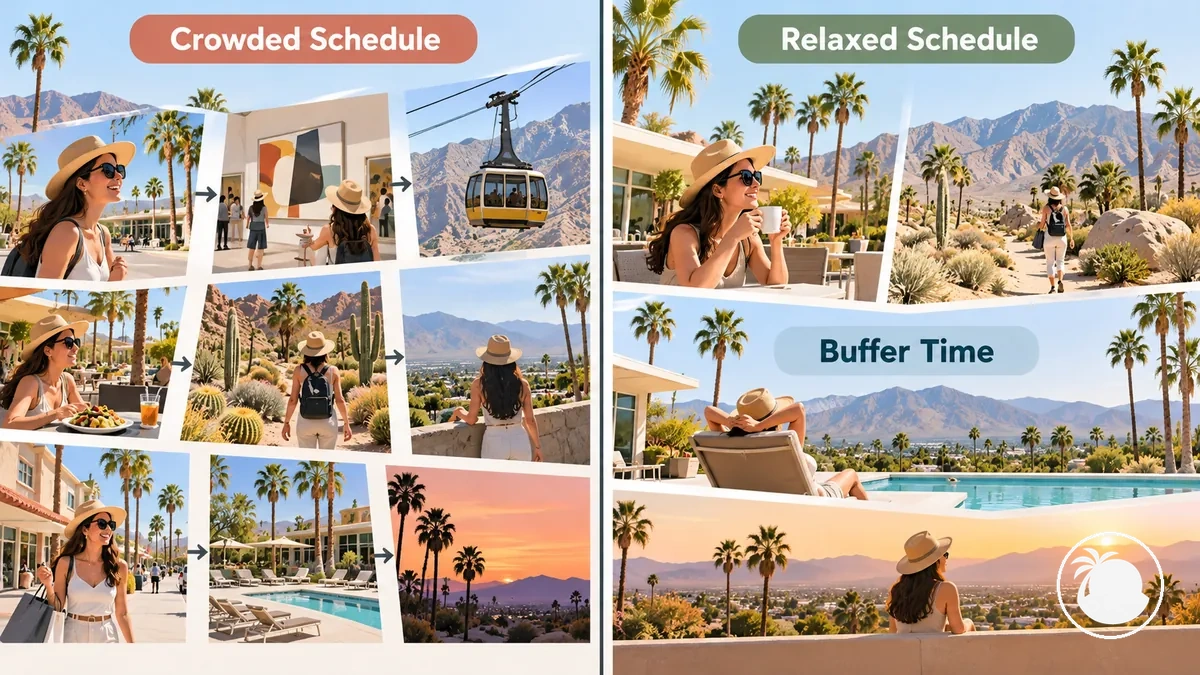
The illustration shows relative schedule density in Palm Springs, contrasting a crowded sequence with a more spaced sequence that protects buffer time rather than prescribing a mandatory timetable.
Pressure signal → practical adjustment
Schedule density: If activities leave little space for meals, transitions, or spontaneous choices, shorten an activity block or reduce the number of commitments competing for the same part of the day.
Travel time: If distance or backtracking consumes a disproportionate share of usable time, remove a distant stop or replace it with an activity closer to the rest of the day's plan.
Fixed reservations: If multiple fixed reservations constrain the sequence, protect the commitments that matter and keep surrounding activities flexible rather than adding more fixed timing.
Energy demand: If demanding activities leave too little recovery time for the intended pace, shorten the demanding block or shift another activity to a less pressured period.
Weather exposure: If conditions make an exposed activity more demanding, shift it to a more suitable part of the day when practical and keep the surrounding schedule flexible.
Recovery time: If the baseline schedule repeatedly crowds out downtime, protect a recovery period by shortening a flexible activity instead of compressing every transition.
For example, a baseline day that combines a demanding activity with a distant secondary stop may leave little buffer after travel and transitions.
Removing the distant stop while keeping the primary activity reduces travel pressure and restores usable buffer time for meals, recovery, or a spontaneous nearby choice, preserving flexibility without turning the four-day plan into a different itinerary.
Group Activities by Area to Reduce Backtracking
Grouping genuinely nearby activities within the same area reduces repeated travel and backtracking, protecting more usable time for sightseeing and a relaxed daily pace.
Keep a distant activity separate when reaching it would add enough transfer friction to disrupt an otherwise coherent activity cluster.
Proximity should be evaluated from the actual locations rather than assumed because two stops share a broad area name.
Distance between stops, transport mode, and the resulting travel time determine whether activities form a practical local group.
A cluster that works with one transport mode may not work as efficiently with another, so the relevant route should be checked before treating stops as nearby.
When a transfer creates substantial backtracking, assigning that activity to another block protects the pace of the current one.
Use these grouping rules to distinguish activities that naturally fit together from those that add unnecessary transfer friction.
Each bullet describes a clustering principle or local group rather than a complete neighbourhood inventory.
Same local area: Combine stops when their actual locations are close enough for the chosen transport mode to make the transfer practical within one activity block.
Natural route progression: Group activities when moving from one to the next continues through the same area instead of requiring a return toward a place already visited.
Shared transport pattern: Keep activities together when the same transport mode connects them without introducing an awkward transfer that consumes usable time.
Distant or disconnected stop: Separate an activity when its location would require leaving the current geographic cluster and then backtracking to continue the rest of the planned block.
For example, two or three confirmed nearby stops can form one coherent route-style activity cluster, while a fourth stop that requires a separate outward transfer can be assigned elsewhere.
This keeps the daily route focused on proximity without assuming unverified distances or exact travel times.
Balance Longer Sightseeing Blocks With Downtime
Longer or more demanding sightseeing blocks may warrant a lower-commitment period afterward when energy, heat exposure, or travel effort puts more pressure on the day's pace.
A compact, low-effort sightseeing block may leave less need for downtime, so the balance should change with the activity load rather than follow a fixed rest formula.
Activity duration affects how much of the day a sightseeing block occupies, while physical effort changes how demanding that block is for the traveller.
Heat exposure and travel effort can add to the overall activity load, making a slower next block more appropriate in some conditions.
Recovery needs also differ by traveller and by day, so downtime can expand after a longer or more demanding block and contract when the preceding activities are shorter and lower effort.
This keeps the planning decision tied to itinerary pace rather than an assumed exact recovery time.
Match the next block to the activity load
Higher-load block
For example, a long excursion can be followed by a meal and hotel downtime instead of another substantial sightseeing block, while a physically demanding activity may pair better with a slow walk or another low-commitment period afterward.
Lower-load block
By contrast, a compact day of lower-effort nearby activities may support another flexible activity with less downtime between blocks.
These pairings are planning examples, not fixed recovery requirements, so the next-block intensity should remain conditional on the day's activity load and the traveller's preferred pace.
How to Adjust the Itinerary for Different Trip Constraints
Keep the four-day itinerary framework stable, but adjust its timing, geographic reach, or daily intensity when a trip constraint materially changes what is feasible.
The constraint should modify how the existing plan is implemented rather than create a separate four-day itinerary.
Season and usable daylight can shift activity timing or the amount of activity that fits comfortably into a day.
Transport access changes geographic reach when reaching dispersed activities adds transfer time or limits practical connections.
The arrival window and departure window determine how much usable time remains on the boundary days, while excursion feasibility depends on whether the available day, transport arrangements, and current conditions support the additional travel commitment.
These constraints therefore change timing, daily radius, or intensity without changing the underlying four-day structure.
Use the criteria below to identify which planning variable a constraint changes and make the corresponding schedule adjustment.
Season: When seasonal conditions make certain periods of the day less suitable for planned activities, shift timing or reduce activity intensity rather than changing the entire itinerary.
Transport access: When transport access makes dispersed stops harder to combine efficiently, reduce the geographic reach of the day's activity blocks and group plans within a more practical daily radius.
Usable daylight: When less usable daylight is available for an activity that depends on daylight, narrow the activity window or reduce the number of daylight-dependent commitments.
Arrival and departure windows: When either boundary day has limited usable time, reduce its activity intensity and keep fuller sightseeing within the more complete days.
Excursion feasibility: When available time, transport arrangements, or current conditions do not support the additional travel commitment of an excursion, keep that day within Palm Springs rather than forcing the excursion into the framework.
Shift the Daily Schedule Around Summer Heat
In summer heat, shift heat-sensitive outdoor activity toward cooler periods and reserve hotter periods for lower-exposure or more flexible activity when current conditions warrant the change.
Keep the purpose of each day intact while adjusting timing and activity intensity rather than replacing the four-day plan.
Activity suitability depends on the actual temperature and sun exposure, the exertion involved, and whether shade or an indoor option is available.
Hydration access can affect how practical a longer outdoor activity is, while travel time can extend exposure or reduce the flexibility available for moving an activity.
Because these conditions vary by day and activity, use current conditions to decide how far to shift timing rather than applying a fixed temperature threshold or universal time band.
The criteria below connect exposure conditions with schedule shifts so that outdoor activity, lower-exposure periods, and flexible activity can change position without changing the day's overall purpose.
Temperature and sun exposure: When an outdoor activity would involve greater heat exposure, shift it toward a cooler period and use the hotter period for a lower-exposure or flexible activity.
Exertion: When an outdoor activity involves greater physical effort, favor a cooler period when conditions support that adjustment rather than placing the most demanding block in a hotter period.
Shade or indoor option: When shade is limited, move the more exposed activity to a more suitable period; when a practical indoor option is available, it can occupy a hotter part of the day.
Hydration access and travel time: When hydration access is limited or travel adds substantial exposure, shorten, relocate, or shift the affected activity instead of treating its original timing as fixed.
For example, on a hot day, a more exposed or higher-exertion sightseeing block can move to a cooler period while a meal, indoor option, or other low-exposure activity occupies the hotter period, preserving the same overall day purpose.
More detailed guidance on planning activities around summer heat belongs outside this itinerary-level adjustment.
Keep Car-Free Days Compact and Focused on Walkable Areas
Without a car, keep each Palm Springs day geographically compact and reduce the number of transfers between activity clusters.
A smaller daily radius can preserve more usable time for nearby activities when each transfer may add waiting time or uncertainty.
The practical daily radius depends on accommodation location, the actual walkability between planned stops, transfer frequency, and the waiting time associated with another transport mode.
Heat exposure can also reduce the suitability of a longer walking connection, while access to a non-walkable attraction may require local transit, rideshare, cycling, or a tour.
Because these conditions vary by location and time, treat each connection as an access decision rather than assuming that all activities within Palm Springs form one walkable area.
The access patterns below distinguish activities that can form a compact walkable cluster from those that may need another transport mode, classifying transfer friction and grouping choices rather than transport brands, fares, or guaranteed availability.
Walkable activity cluster: Group nearby activities when their actual locations and current conditions make the connections practical on foot, keeping the daily radius compact and avoiding an extra transfer.
Single-transfer cluster: When a useful group of activities lies outside the practical walking radius, one local transit or rideshare transfer may keep the group workable without repeatedly crossing between distant areas.
Access-dependent activity: A non-walkable attraction may need cycling, a tour, local transit, or rideshare when those options are suitable and available; account for the added transfer and possible waiting time before adding it to the day.
Higher-friction combination: Separate activities when combining them would require repeated transfers, uncertain connections, or walking exposure that materially expands the day's travel burden.
For example, concentrating several nearby activities into one compact route can reduce transfer frequency compared with moving between dispersed stops throughout the day.
When every additional transfer can add waiting time or uncertainty, that smaller daily radius helps preserve a relaxed pace without simply removing activities from the four-day itinerary.