
Planning Your First Visit to Palm Springs
For a first visit to Palm Springs, build the itinerary around geography, seasonal conditions, trip length, base location and mobility rather than a fixed “must-see” schedule. Keep the highest-priority experiences within realistic daily capacity by counting transfer time and buffer; as distances, heat constraints or transport friction increase, reduce activity density instead of compressing the day.

First-visit planning framework
Build the trip in this order so each decision constrains the next instead of creating a disconnected itinerary.
-
Set the geographic scopeDecide whether priorities cluster around downtown and Palm Springs city or extend across Greater Palm Springs. A wider scope increases transfer demand.
-
Match plans to conditionsUse seasonal conditions and heat tolerance to decide how much outdoor time can fit comfortably and when flexibility is needed.
-
Protect schedule capacityTrip length sets how much activity density, recovery time, geographic spread and optional travel the itinerary can absorb.
-
Align base and mobilityChoose where to stay and whether to drive from the actual geography of your priority activities, not from a universal transport rule.
-
Rank activities by fitProtect essential experiences first, then add desirable or optional stops only when transfer time, energy and buffer still fit.
- 1 day
- Keep the scope tight and priorities selective.
- 2 days
- Use the extra capacity for a broader core, not automatic overbooking.
- 3–4 days
- Use added time for buffer, a slower pace, wider spread or an optional excursion.
Planning rule: when geographic spread, heat constraints or mobility friction rise, lower the number of fixed stops and preserve more schedule flexibility.
Start with geography: Palm Springs city is the local planning frame, while Greater Palm Springs is a broader regional frame. That distinction changes how much transfer time, transport planning and daily buffer a first visit may need.
Table of Contents
How Palm Springs Is Laid Out for First-Time Visitors
Palm Springs city is the local planning frame, with downtown Palm Springs forming its most concentrated visitor core. Greater Palm Springs is the broader multi-city Coachella Valley visitor region, so a place described with the regional label may sit well beyond downtown.
This geography matters because attractions associated with a Palm Springs trip can be concentrated near downtown or dispersed across a broader area, changing the distance and travel effort between them.
The diagram clarifies how downtown Palm Springs sits within Palm Springs city while Greater Palm Springs provides the broader regional context.
It shows spatial concentration and separation rather than exact distances or transfer times.
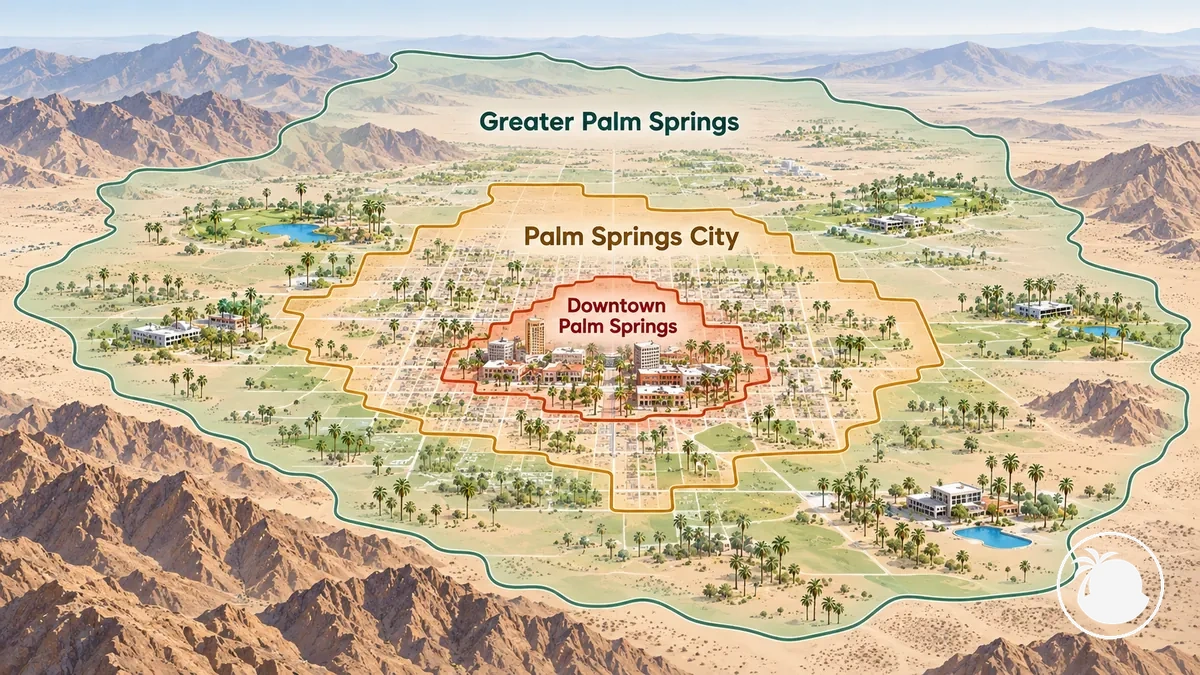
Greater concentration can support more walking and reduce transfer effort, while dispersed locations increase the importance of distance, parking or pickup arrangements, and other mobility conditions.
Walkability therefore depends on the specific starting point and destination rather than applying equally across Palm Springs city.
As activities become more dispersed, transfer time can reduce how many separate attractions reasonably fit into the same day.
“Palm Springs” may refer narrowly to Palm Springs city, while “Greater Palm Springs” is a broader regional label that can encompass multiple cities.
Recognising that difference in geographic scope prevents a regional listing from being mistaken for a downtown or city-centre location and makes the city-versus-region distinction important for planning.
Palm Springs City vs Greater Palm Springs
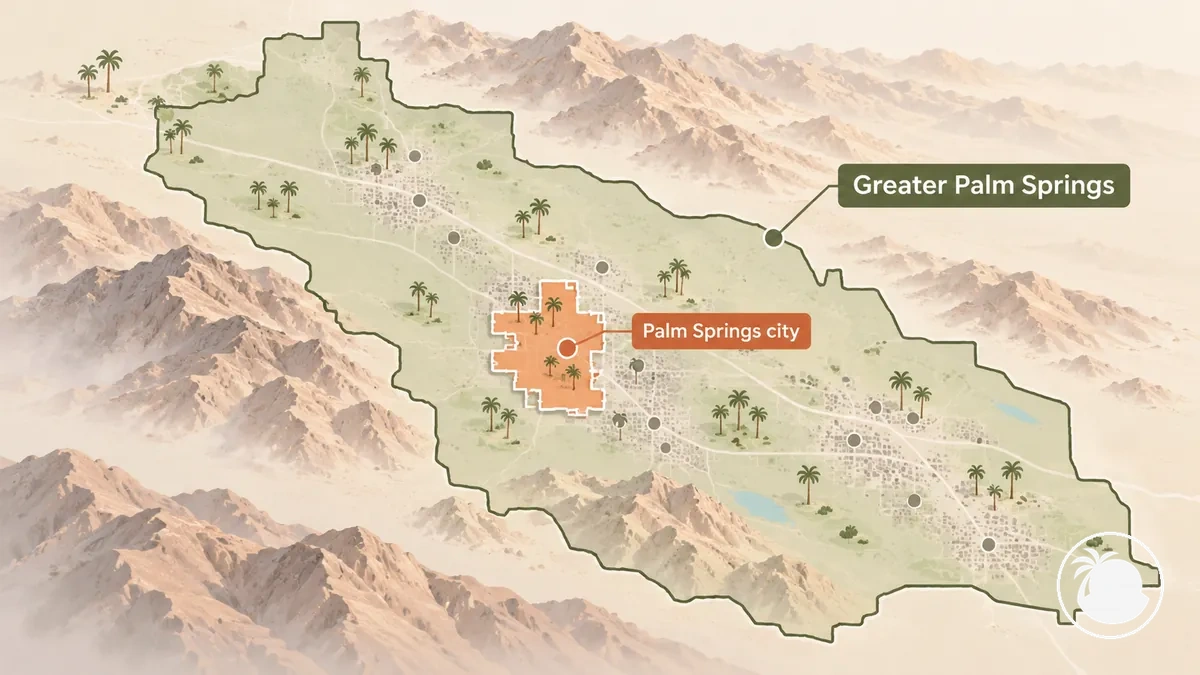
Palm Springs city and Greater Palm Springs refer to different geographic scopes: the first follows a city boundary, while the second is a wider regional label that can cover multiple cities.
The table compares their geographic scope, included places, dispersion, and how distance can change travel time and transport assumptions.
The comparison graphic reinforces geographic scope rather than destination quality by making the narrower city boundary visually distinct from the wider regional context.
| Scope | What It Refers To | Spatial Pattern | Planning Implication |
|---|---|---|---|
| Palm Springs city | The city proper within the Palm Springs city boundary | A narrower geographic scope that includes downtown and other locations within the city | References within the city still vary by location, but they use a narrower scope for judging distance and travel time |
| Greater Palm Springs | A broader regional label that can cover multiple cities across the wider valley | A more dispersed geographic scope, so referenced places can be separated by greater distances | The specific location should be checked before making travel-time or transport assumptions |
A hotel, attraction, or itinerary reference described under Greater Palm Springs can therefore involve more travel than a reference specifically located in downtown Palm Springs, depending on the actual origin and destination.
Checking whether a listing refers to Palm Springs city or the wider region prevents the regional label from creating misleading distance, travel time, or transport assumptions.
Downtown and Attractions Beyond the City Centre
Downtown Palm Springs concentrates more visitor stops within a compact core, so walkability can make consecutive nearby activities easier to group, while destinations beyond the city centre can require additional transfer planning.
The annotated location graphic clarifies how concentration versus dispersion changes transfer effort without implying exact travel times.
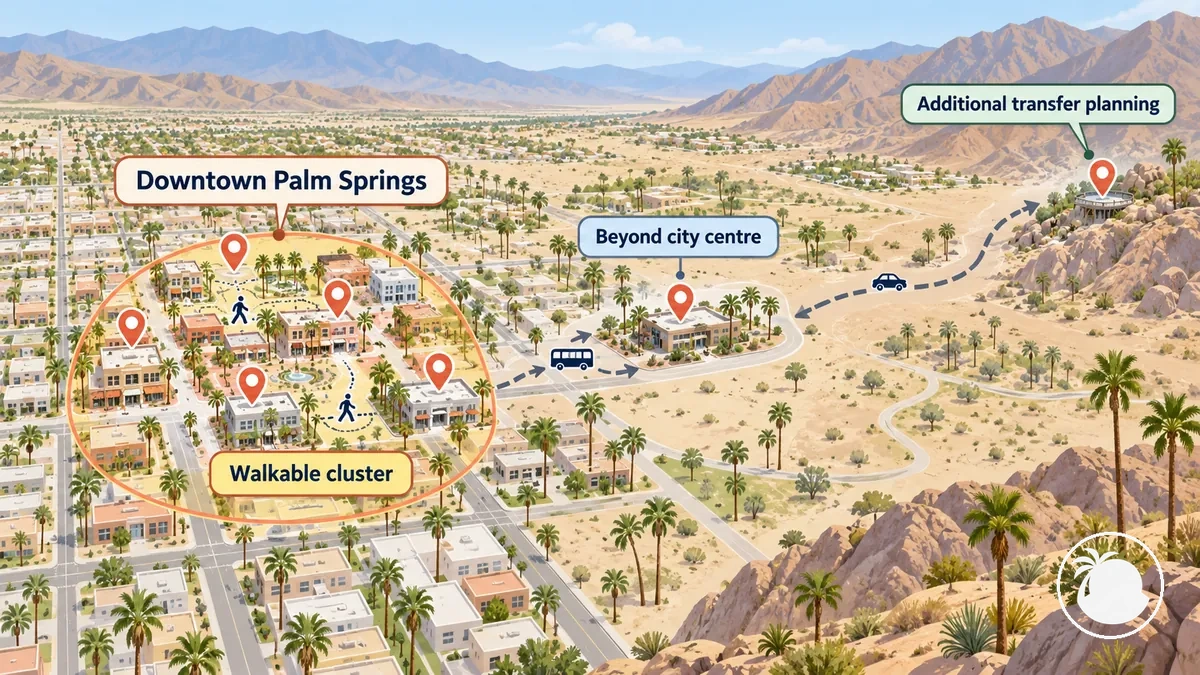
Distance is only part of that planning cost because parking or pickup, traffic variability, and backtracking can also add transfer time.
These factors become more relevant as activities are spread across separate locations rather than concentrated around downtown.
Greater transfer friction can reduce activity density by leaving less of the available time for the activities themselves.
- Downtown cluster: A compact group of stops around downtown Palm Springs can support walking when the specific destinations are close enough, limiting transfer time and making several nearby stops easier to combine.
- In-city destinations outside the core: Locations beyond the downtown cluster involve more distance from the city centre, so a car or rideshare may be practical depending on the destination and visitor circumstances; parking or pickup can add transfer friction and reduce the number of comfortable stops.
- Farther regional attractions: More dispersed outlying attractions can require greater reliance on motorised transport and a larger allowance for transfers, traffic variability, and backtracking, so realistic daily capacity may be lower than for a tightly grouped downtown plan.
The Main Decisions to Make Before Your Palm Springs Trip
A Palm Springs trip plan works best when travel timing, trip length, base location, and mobility are treated as connected decisions because each choice constrains the others.
Seasonal conditions can change outdoor comfort and usable hours, while available time changes how much travel load and activity density the schedule can absorb.
The diagram shows how one planning choice can constrain the next rather than presenting four isolated preferences.
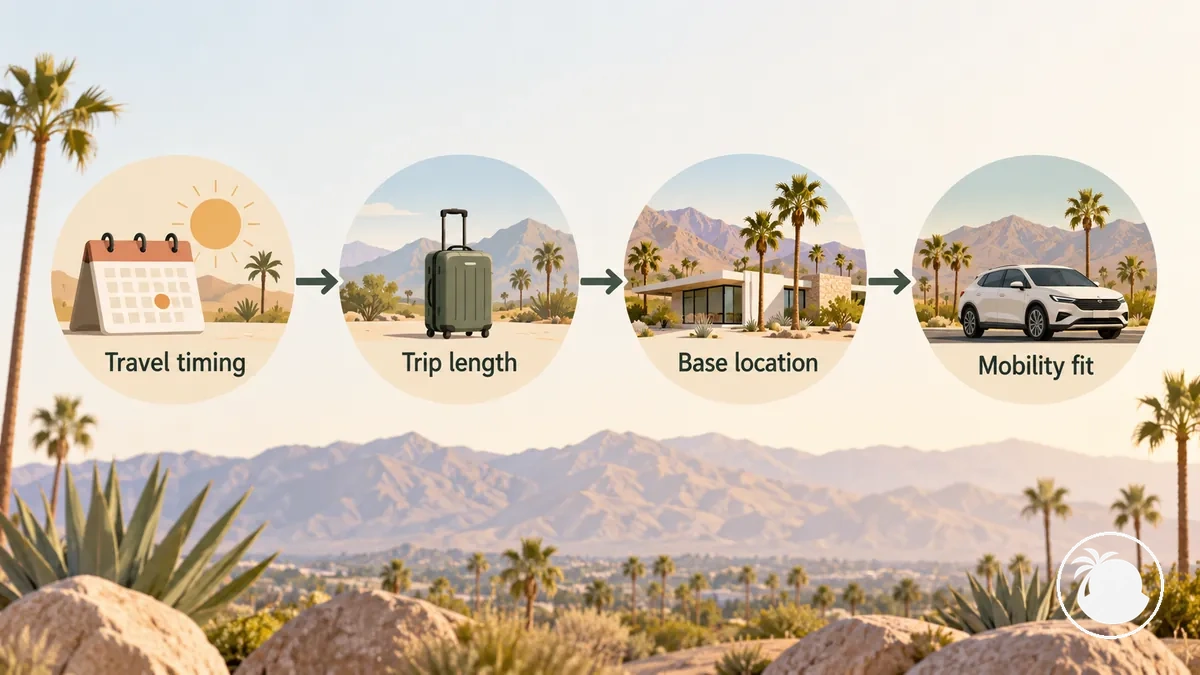
The dependency usually starts with fixed dates and conditions, then moves through available time, base location, and transport fit, although a different fixed constraint may change where an individual traveller begins.
The resulting choices affect access, daily travel load, and usable hours.
For consistency, travel timing, trip length, base location, and mobility should support the same activity priorities.
- Travel timing and conditions: Start with fixed dates and the seasonal conditions attached to them, because they shape outdoor comfort and the usable hours available for planned activities.
- Trip length and pace: Define the available days and intended pace within those conditions; more limited usable time reduces the amount of transfer time and optional activity that can be added without crowding the schedule.
- Base location: Match the accommodation base to the geography of the activity priorities, because proximity changes daily travel load and the flexibility to group activities efficiently.
- Mobility fit: Check whether the available mobility options support access to the resulting mix of nearby and dispersed attractions, because poor transport fit can add transfer effort and reduce comfortable schedule capacity.
Choose When to Visit
When to visit Palm Springs depends on the outdoor activities you plan, your heat tolerance, your preferred pace, and how much of the day you want to spend outdoors rather than on one universally best month.
Season, temperature, and weather pattern can change the daily activity window, so timing suitability depends on how those conditions fit the trip you want to take.
The comparison graphic shows how cooler and hotter conditions can change outdoor scheduling and midday flexibility rather than representing an exact weather forecast.
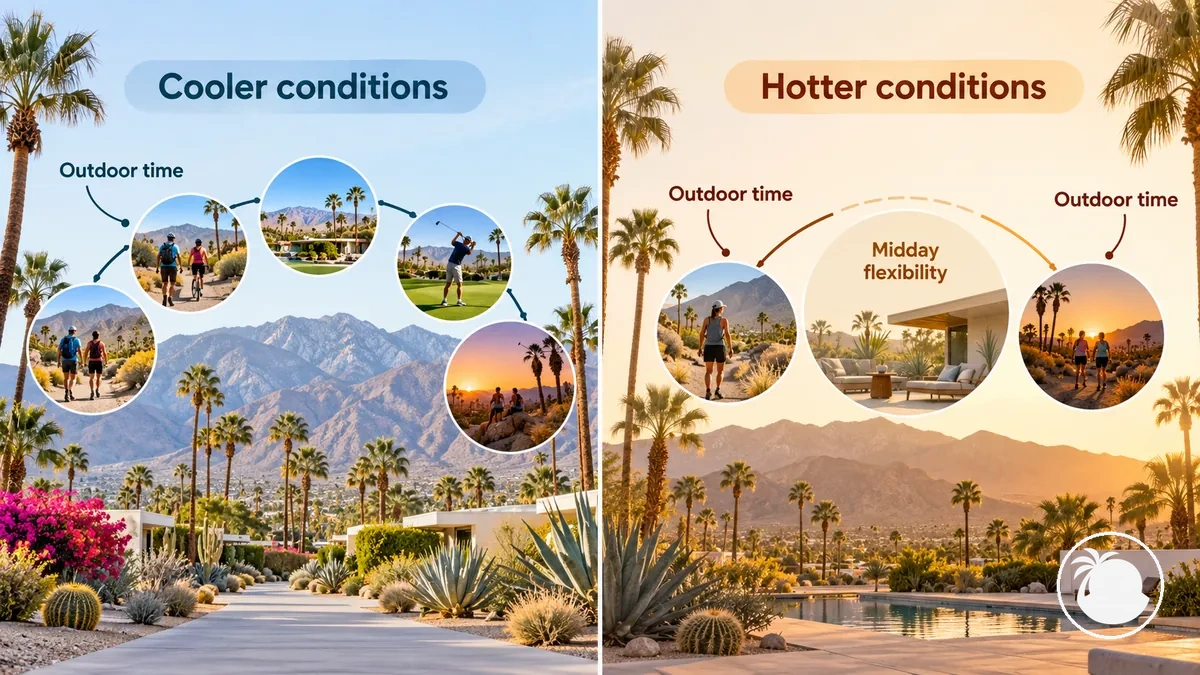
Cooler conditions tend to allow greater flexibility for outdoor activities across the day, while hotter conditions can narrow comfortable outdoor windows and shift more activity toward cooler parts of the day.
That difference can require greater midday flexibility and a slower pace when outdoor time is a priority, while travellers planning more flexible or indoor time may be less constrained by the same conditions.
For deeper seasonal and month-specific guidance, see the best time to visit Palm Springs.
- Outdoor exposure: A season or month is more suitable when its expected conditions support the amount and timing of outdoor activity you want, while hotter conditions may narrow the practical daily activity window.
- Heat tolerance: Travellers with lower heat tolerance may prefer cooler conditions when outdoor activities are central to the trip, while greater tolerance can make hotter periods workable with adjusted timing.
- Desired pace: A fuller outdoor schedule is easier to accommodate when conditions allow more flexibility across the day, whereas hotter weather can favour a slower pace with activity concentrated in cooler periods.
- Schedule flexibility: A trip with room to shift outdoor plans toward morning or evening and keep midday flexible can adapt more readily to hotter conditions or changing weather patterns.
Decide How Many Days to Stay
Trip length sets schedule capacity rather than prescribing a fixed itinerary: one day is a compressed sampler, two days give more room for a core set of priorities, and three to four days add more buffer for a slower pace, wider geographic spread or an optional excursion.
The comparison graphic shows how that capacity expands as more days become available rather than prescribing fixed itineraries or guaranteed attraction counts.
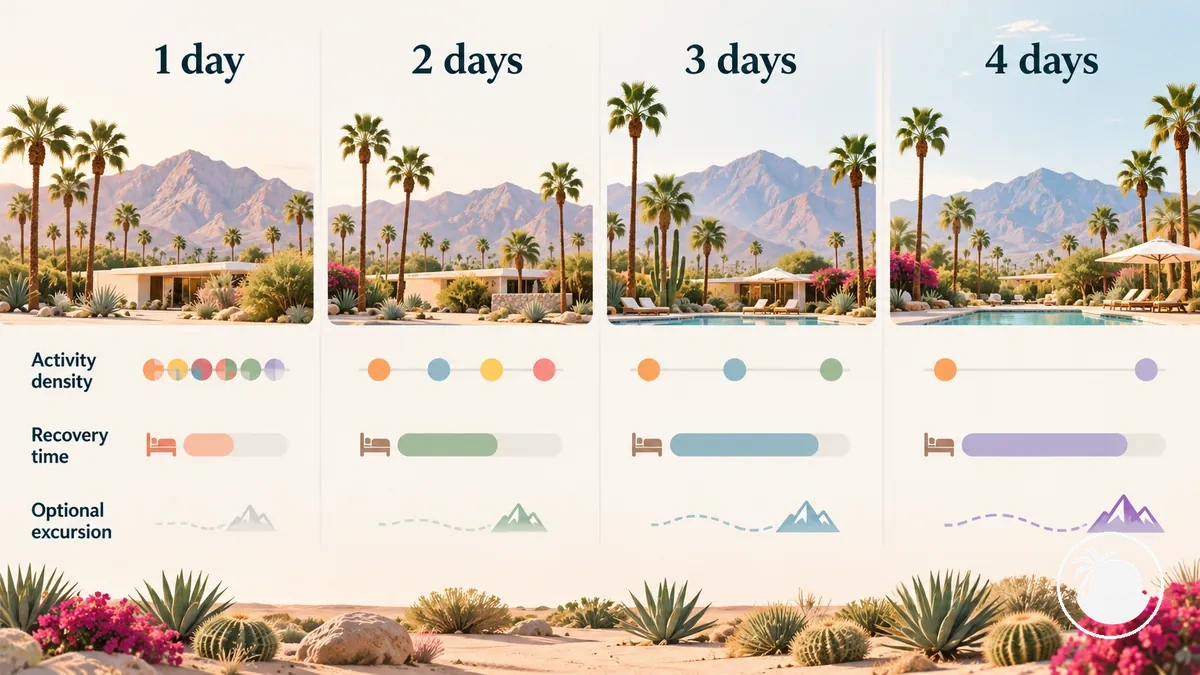
With one day, priorities need tighter selection because higher activity density leaves limited recovery time and less capacity for geographic spread or an optional excursion.
With two days, activity density can be lower and some additional buffer becomes easier to retain, although spreading priorities across distant locations still consumes planning capacity.
The additional day therefore reduces compression and increases choice without requiring more stops.
Three days can provide more room to balance activity density, recovery time, and geographic spread when that allocation suits the visitor's interests, season, and pace.
Four days can support a slower pace, greater recovery time, or an optional excursion without requiring every extra period to contain another activity.
The four durations below compare planning capacity rather than prescribed itineraries, reinforcing that extra days primarily buy flexibility around priorities rather than automatically adding more stops.
- One day: Activity density is highest when several priorities are retained, recovery time is limited, geographic spread needs tighter control, and an optional excursion is difficult to add without displacing a higher-priority Palm Springs experience.
- Two days: Activity density can be lower, some recovery time becomes easier to retain, priorities can cover a broader geographic spread, and an optional excursion becomes more feasible only when it does not crowd the core priorities.
- Three days: Activity density can be distributed more evenly, recovery time can provide a larger buffer, a broader geographic spread becomes easier to manage, and an optional excursion can fit more readily when interests, season, and pace support it.
- Four days: Activity density can remain lower, recovery time and schedule buffer can increase, dispersed priorities can be accommodated with greater flexibility, and an optional excursion becomes easier to include without requiring the extra time to be filled with additional stops.
Choose Where to Base Yourself
Your Palm Springs base location should match where you expect to spend time, how you plan to move around, and how much transfer time you are willing to accept.
Proximity to priority activities can reduce repeated travel burden, while the value of centrality or a more dispersed setting depends on the geography of your plans and your transport method.
A central base can make walkability and access to dining or services more useful when much of the trip is concentrated nearby, while a dispersed resort setting can fit a more car-based plan when its location aligns with priority activities.
Parking or pickup convenience also affects transfer time and schedule flexibility, particularly when repeated journeys would consume a larger share of a short stay.
Use these criteria to assess location fit, with the fuller where to stay in Palm Springs comparison covering accommodation-location choices in more detail.
The five criteria below evaluate how a base location affects time and access rather than hotel quality.
They move from proximity to mobility and transfer logistics without assuming that one location pattern suits every trip.
- Proximity to priorities: A base closer to the priority activities that occupy most of the trip can reduce repeated transfer time and leave more schedule flexibility for those activities.
- Walkability and services: If dining or services and several planned stops are concentrated nearby, walkability can reduce the need for separate transfers; if priorities are dispersed, that advantage may apply to only part of the trip.
- Transport fit: A central location can suit a trip built around nearby activities and walking, while a more dispersed base can remain practical when car-based outings already shape the activity geography.
- Parking or pickup: Convenient parking or pickup can reduce transfer friction when driving or rideshare is part of the plan, while less convenient access can add time between the base and planned activities.
- Transfer-time tolerance: Greater centrality can reduce repeated travel when priorities cluster nearby, whereas accepting a more dispersed setting can increase daily travel burden in exchange for a base that better matches other priorities; the useful trade-off depends on how much transfer time the schedule can absorb.
Decide Whether You Need a Car
A car becomes more useful as your priority activities spread beyond walkable stops near your base or include outlying attractions. It is less necessary for a compact plan concentrated around places you can reasonably reach on foot.
Parking tolerance, rideshare or transit practicality, group mobility and the flexibility you want between dispersed destinations still change the trade-off.
Driving can reduce some transfer constraints between dispersed destinations, but it can also add parking and driving friction.
Rideshare or transit practicality depends on the actual destinations and timing, while group mobility needs can also change whether a car adds useful flexibility.
Use the criteria below to assess the trade-off, with the fuller whether you need a car comparison covering the transport decision in more detail.
The six criteria below identify conditions that change the value of a car rather than provide a universal yes-or-no answer.
They move from activity geography to transport logistics and personal mobility needs.
- Base location: A base near a concentrated group of planned stops can reduce the need for driving, while a base separated from priority activities can increase the usefulness of a car for repeated transfers.
- Walkable activities: When much of a short stay centres on activities that can reasonably be reached on foot from the base, car use may add less access or schedule flexibility than it would for a more dispersed itinerary.
- Outlying attractions and excursions: Plans involving outlying attractions or excursions create greater mobility demand, so a car can be more useful when those destinations would otherwise require multiple separate transfers.
- Parking tolerance: Driving can add flexibility between dispersed stops, but the value is lower for travellers who prefer to avoid finding parking and managing a vehicle between activities.
- Rideshare or transit practicality: A car may be less useful when rideshare or transit provides practical access for the specific destinations and timing planned, while less suitable alternatives can increase the value of driving.
- Group mobility: Group size, individual mobility needs, and the need to move together can change transport fit, so a car may add flexibility for some groups while creating unnecessary driving or parking friction for others.
How to Set Priorities for a First Visit
First-visit activity priorities in Palm Springs should reflect personal relevance and planning cost rather than popularity alone.
Limited time requires trade-offs, so an activity that strongly matches your interests may deserve higher priority than a popular option that consumes disproportionate time or fits the trip poorly.
A useful activity choice therefore weighs what matters to you against the constraints that determine what can realistically fit.
Evaluate each candidate activity through five criteria: personal relevance, total time commitment, geographic fit, seasonal or timing fit, and opportunity cost or substitutability.
Time commitment includes the activity itself plus associated travel time and energy demand, while geographic fit improves when locations can be grouped without unnecessary backtracking.
Seasonal suitability and timing constraints can reduce flexibility when an activity depends on particular conditions, an operating window, or a reservation, while opportunity cost rises when choosing it displaces something more relevant or harder to substitute or postpone.
The criteria below organise these trade-offs consistently without turning priority into a numerical score.
Priority criteria at a glance
- Personal relevance
- Priority rises when an activity closely matches the interests that motivated the first visit; popularity alone does not make an activity equally valuable to every visitor.
- Total time commitment
- Consider the activity, travel time, and energy it consumes relative to daily capacity; a longer commitment can remain a high priority when its personal relevance justifies what it displaces.
- Geographic fit
- An activity gains practical fit when its location works with other priorities and reduces avoidable backtracking, while an isolated location can consume more of the time available for other choices.
- Seasonal and timing fit
- Seasonal suitability, operating windows, reservation sensitivity, and other timing constraints can raise priority when postponing the activity would make it difficult to include under the conditions of the current trip.
- Opportunity cost and substitutability
- Priority tends to rise when an activity is difficult to substitute or postpone and its inclusion does not displace something the visitor values more; an easily deferred alternative can take lower priority when time is tight.
For example, a visitor mainly interested in architecture may rationally prioritise an architecture-focused activity, while another visitor choosing from the same activity set may give more priority to outdoor experiences because those have greater personal relevance and seasonal suitability for that trip.
Both choices can be coherent when time commitment, geographic fit, timing constraints, and opportunity cost support the traveller's priorities.
The next planning task is to balance those major sights and personal interests against the time actually available.
Balance Major Sights With Available Time
High-priority Palm Springs sights should fit within the available time while leaving a buffer for transfers, meals, rest, and normal variability rather than filling every open hour.
Schedule capacity is finite because each activity uses both time and energy.
The practical trade-off is to protect the experiences that matter most while allowing lower-priority additions to remain flexible.
Time demand, location compatibility, and energy cost can move an activity between essential, desirable, and optional for a specific trip.
An appealing sight may become lower priority when it requires substantial transfer time, conflicts with nearby activities, or consumes energy needed for a more relevant experience; the broader things to do on a first visit can therefore be filtered according to the capacity of this trip.
The three tiers below organise inclusion trade-offs for the specific traveller and trip length rather than rank attractions universally.
Use three inclusion tiers
- Essential
- An activity is essential for this trip when it has high personal relevance, its time demand and location compatibility fit the available time, and including it still leaves workable schedule capacity for necessary transfers and buffer.
- Desirable
- An activity is desirable when it remains personally relevant and fits the location pattern, but its inclusion depends on extra time, sufficient energy, and enough flexibility after essential activities are protected.
- Optional
- An activity is optional when its time demand, location compatibility, or energy cost would displace a higher-priority experience or reduce the buffer too far; removing it can improve schedule resilience on a shorter visit, while greater schedule capacity can make it easier to include on a longer stay.
Account for Travel Time Between Activities
Transfer time is part of the real activity budget, so geographically separated Palm Springs stops consume more of the day than their activity duration alone suggests.
- Activity duration
- Count the expected on-site time an activity consumes because that time directly reduces the schedule capacity available for other stops.
- Transfer friction
- Allow for distance, parking or pickup, traffic variability, a start-time constraint, and backtracking because each can add transfer time beyond the movement between locations itself.
- Buffer
- Keep contingency time around transfers and fixed commitments so variation in traffic, parking or pickup, or activity duration does not immediately make later plans unrealistic.
The size of transfer friction and the useful buffer depend on the specific locations, conditions, and timing, so a fixed travel-time or buffer allowance does not apply to every Palm Springs plan.
Parking or pickup and backtracking can consume meaningful schedule capacity in addition to geographic distance, while clustering compatible activities can reduce repeated transfers.
A dispersed plan may therefore require fewer stops than a clustered plan with the same number of candidate activities, leaving enough capacity for variable travel conditions and fixed start times.
Keep Optional Excursions Proportionate to Trip Length
An optional excursion is proportionate to a first Palm Springs visit only when its total time cost and logistics fit the trip length without displacing higher-priority Palm Springs experiences.
Round-trip travel reduces local time as well as adding transport requirements, so an interesting excursion is not automatically a suitable use of a compressed stay.
The six criteria below evaluate that opportunity cost for the specific trip rather than rank excursions.
- Trip length: An excursion is easier to justify when the stay has enough schedule capacity to preserve higher-priority local experiences; on a shorter visit, the same excursion can consume a larger share of available local time and may be better dropped.
- Round-trip travel: Include the complete round-trip travel demand in the total time cost, because outbound and return logistics reduce the time and flexibility remaining for Palm Springs activities.
- Uniqueness: Greater uniqueness can increase an excursion's relevance when the experience is difficult to substitute locally or postpone, but uniqueness alone does not outweigh disproportionate travel demand or displacement.
- Seasonal suitability: Keep the excursion when expected seasonal conditions fit the intended experience and schedule; if conditions reduce its usefulness or require substantial schedule adjustment, its opportunity cost increases.
- Transport requirements: Consider whether the required transport and associated logistics fit the trip's mobility plan, because additional transport complexity can reduce pace flexibility and schedule resilience.
- Opportunity cost: Compare the excursion with the Palm Springs experiences it would displace; keep it when that trade-off matches the visitor's priorities, and drop or defer it when preserving local time has greater value.
The same excursion can be disproportionate on a very short, compressed visit yet reasonable on a longer stay with more schedule capacity, depending on its uniqueness, seasonal suitability, transport requirements, and opportunity cost.
A longer trip does not automatically make an excursion worthwhile, because round-trip travel and logistics still compete with local time.
Preserving enough local time and flexibility for higher-priority experiences supports schedule resilience and a manageable pace.
Common First-Visit Planning Mistakes
Most first-visit planning mistakes in Palm Springs come from a mismatch between expectations and the trip's actual geographic scope, seasonal conditions, available time, base location, or mobility constraints.
Use the matrix below to match each recurring planning mismatch with its likely consequence, a recognition cue and a practical correction.
| Planning mismatch | Consequence | Recognition cue | Correction |
|---|---|---|---|
| Confusing geographic scopeTreating Palm Springs city and the wider Greater Palm Springs area as if every referenced place were in the same compact area. | The plan can underestimate distance and create unrealistic travel assumptions. | Planned stops described as being in the wider region are assumed to be close to downtown without checking their actual location. | Confirm the geographic scope and location of priority activities before estimating daily travel demand. |
| Overbooking the daySetting activity density from on-site duration alone and leaving little buffer. | Transfer friction, meals, rest, or a delayed activity can make later plans less resilient and increase fatigue. | The schedule depends on each activity finishing and each transfer occurring with little flexibility. | Reduce overbooking by matching priorities to realistic schedule capacity and retaining buffer. |
| Ignoring seasonal conditionsPlanning outdoor activities as though the usable outdoor window and preferred pace remain unchanged across conditions. | The intended schedule may require more adjustment than expected when conditions are less suitable for prolonged outdoor activity. | Outdoor plans occupy fixed parts of the day without allowing their timing or pace to change with expected conditions. | Recheck seasonal conditions and adjust outdoor timing, flexibility, or activity load accordingly. |
| Underestimating transfer timeCounting distance while overlooking parking or pickup, traffic variability, and backtracking. | Transfers can consume more schedule capacity than the plan allows. | Consecutive activities are geographically dispersed but the schedule contains little allowance between them. | Treat transfer time as part of the activity budget and cluster compatible locations where that supports the day's priorities. |
| Mismatching the base locationChoosing a base location without comparing it with the priority geography of the trip. | Repeated transfers can increase daily travel burden and reduce schedule flexibility. | Most planned activities require repeated journeys away from the base even though another location pattern would align more closely with the itinerary. | Reassess the base according to proximity, mobility needs, and acceptable transfer time rather than accommodation preference alone. |
| Making an unqualified transport assumptionAssuming a car is necessary for every plan or that walkability, rideshare, or transit will suit every activity pattern. | The chosen transport approach may not match the actual distances, outlying activities, parking tolerance, or group mobility needs. | The transport assumption was made before the base location and activity geography were defined. | Match the transport choice to the final combination of base location, walkable activities, dispersed destinations, and required schedule flexibility. |
Correcting these planning mistakes means returning to the criterion that is out of alignment: geographic scope, seasonal conditions, time budget, base location, or transport fit rather than applying one universal rule.
A first-visit plan becomes more internally consistent when those constraints support the same priorities and preserve realistic pacing and flexibility.